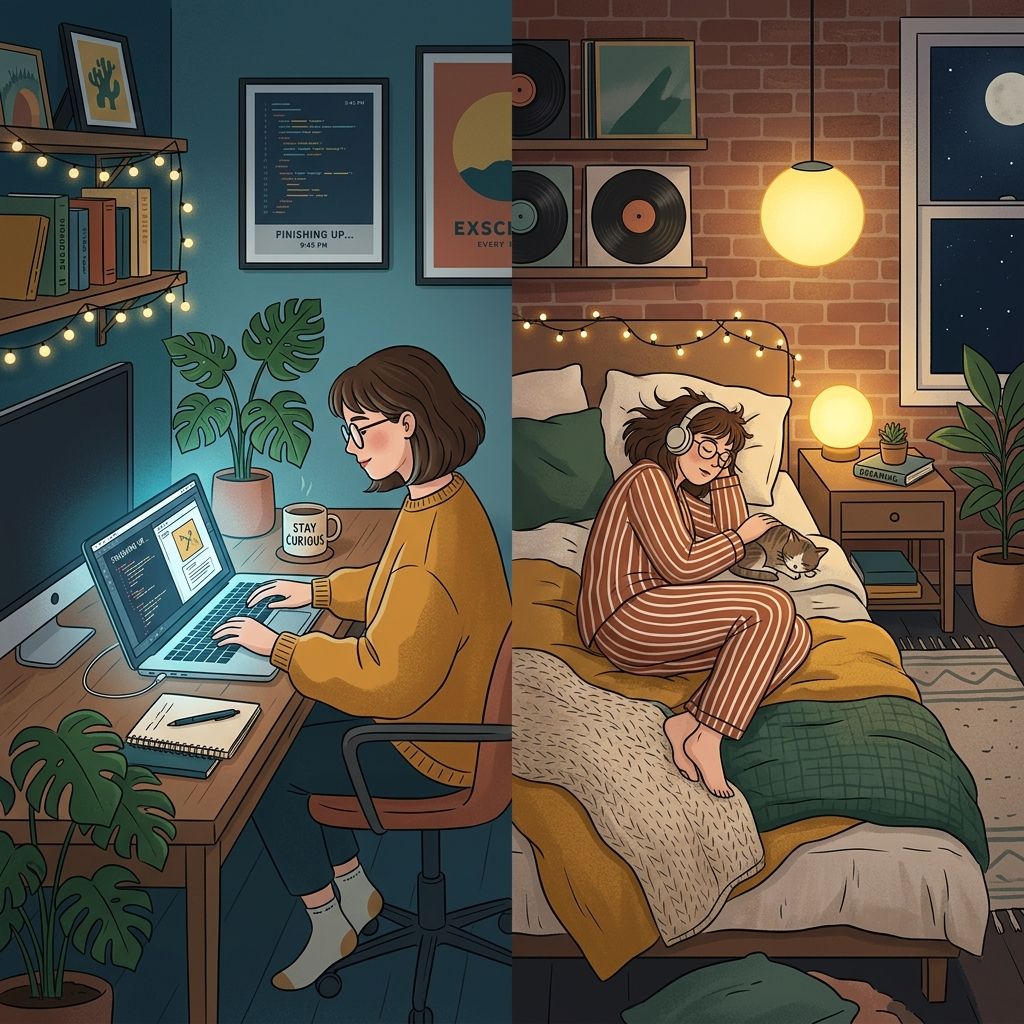
Sitting in front of the computer typing all day, you lie in bed after work. Your body is clearly exhausted, but your brain keeps spinning as if running in an infinite loop.
You might still be thinking about the unresolved problems from today, what to report in tomorrow’s meeting, or how to arrange the weekend schedule.
Your body is already crying out for sleep, but your brain completely “refuses to shut down”.
This is the most common sleep trouble for modern office workers, and it is not just as simple as “thinking too much.”
Why Is It So Hard for Office Workers’ Brains to “Shut Down”?
For those who face screens all day and use their brains heavily, the brain faces a unique modern issue called “cognitive overload”.
Your brain processes massive amounts of information all day long. Even after work, the electrical signals in your cerebral cortex are still surging.
There are three “accomplices” behind this:
Blue Light Deceives the Brain
High-energy blue light emitted by screens directly stimulates the photoreceptor cells on the retina, tricking the brain into thinking “it is still noon”.
This severely suppresses the secretion of
melatonin, preventing the body’s core temperature from dropping and trapping you in light sleep all night.
Even if you close your eyes, if you had high exposure to blue light beforehand, the brain’s pineal gland will still think “it’s not bedtime yet” and refuse to initiate the deep sleep program.
Sustained Sympathetic Hyperactivity
High-intensity brain use keeps the sympathetic nervous system (gas pedal) floored all day. Under normal circumstances, the body should switch to the parasympathetic nervous system (brakes) after work, but the stress hormone cortisol remains abnormally high when it shouldn’t be.
| Normal Cortisol Rhythm | Common Disrupted Rhythm in Office Workers |
|---|---|
| Peak at 6-8 AM, helping you wake up | Hard to wake up in the morning, cortisol is stagnant like dead water |
| Begins to slide down from evening, smooth sleep | Abnormally surges at night, brain busy for nothing |
This is why you are dead tired during the day, yet abnormally wired at night.
Sedentary-Induced “Micro-hypoxia”
Sitting for long periods leads to stiff neck and shoulders and reduced thoracic movement, plus many people unconsciously breathe through their mouths.
At night, the brain is actually in a “micro-hypoxia” state, which is why your eyes feel heavy and eye pressure is high upon waking.
What Are the Consequences of the Brain “Refusing to Shut Down”?
If you remain in a state of “body exhausted but brain refusing to shut down” long-term, the consequences are far worse than just “poor energy the next day.”
| Consequence | Description |
|---|---|
| Deep sleep almost disappears | The brain stays in dreaming and light sleep stages all night; muscles and internal organs are not repaired at all |
| Heavy eyes upon waking | Nighttime micro-hypoxia causes dilation of microvessels around the eyes, leading to facial congestion and edema |
| Power off after 2-3 hours of activity | The metabolic waste accumulated in the brain during the day is not cleaned up, and the brain protests as soon as you move |
| Neck and shoulders get tighter and tighter | Tense muscles continue to send “pain” signals to the brain in the middle of the night, generating many micro-arousals |
The 15-Minute “Brain Shutdown Ritual” Before Bed
To save your sleep, you cannot wait until you lie in bed to think of a solution. You need to forcibly hit pause on your brain before bedtime, giving the brain a buffer period to transition from fight mode to sleep mode.
You can quickly enter sleep mode through the following 15-minute bedtime ritual:
Minutes 1-5: Perform a “Brain Dump” (Clear Memory)
Keep a physical notebook and pen by your bed, and write down everything still spinning in your head on paper.
The reason the
brainkeeps running is because it is afraid of forgetting.
When you “materialize” your thoughts on paper, it signals the brain: “Data is backed up; you can clear the cache now.”
Minutes 6-10: Heated Eye Mask + Neck and Shoulder Relaxation
Eyes that look at screens all day need to be treated well.
| Action | How to Do It |
|---|---|
| Warm compress eyes | Use a steam eye mask or electronic heated eye mask (temperature 40-42°C) to relax the ciliary muscles that have been tense all day and promote eye microcirculation |
| Warm compress neck/shoulders | Cover the back of the neck and shoulders with a hot towel or heating pad to force blood back into tense muscles and release daytime stress |
| Acupoint massage | Lightly press the Zanzhu point (depression at the inner end of the eyebrow) and Taiyang point (temple) with your thumbs, massaging each spot 5 times, repeating for 3 rounds |
Minutes 11-15: “4-7-8 De-stress Breathing Technique”
Perform this breathing technique while lying in bed to directly cut off the brain’s over-activation.
- Inhale deeply through your nose for 4 seconds
- Hold your breath for 7 seconds (slightly increases carbon dioxide concentration in the body, prompting systemic microvessel dilation)
- Make a “whoosh” sound with your mouth, exhaling slowly for 8 seconds
Repeat 4 to 6 times. Focus on the sensation of your body sinking and relaxing as you exhale.
Holding your breath for 7 seconds forces the parasympathetic nervous system online, serving as a physiological shortcut to directly cut off brain hyperactivity.
“Brain Cooling” Tips You Can Do During the Day
In addition to the bedtime ritual, some daytime habits can also significantly reduce evening nerve hyperactivity.
Sunbathe for 5-10 Minutes After Waking Up
Within 1 hour of waking up, let natural sunlight shine into your eyes (overcast days are fine, do not look through glass, do not wear sunglasses).
This sets a “timer” for your brain’s biological clock, which will automatically start melatonin after 14-16 hours, letting you naturally feel sleepy tonight when the time comes.
10-Minute NSDR in the Afternoon
Non-Sleep Deep Rest (NSDR) is a technique that does not lead to sleep but quickly cools down the brain.
When you start to feel tired around 2-3 PM, find a quiet place to sit down:
- Turn off screens and close your eyes
- Do 5 rounds of “double inhalation, single exhalation”: inhale through the nose → take another quick sip of air → slowly exhale long through the mouth
- Then shift your attention from “thinking” to “body perception”: feel the temperature of your hands, the contact of the soles of your feet on the floor
These 10 minutes help the brain perform a “midway micro-recharge,” preventing the sympathetic nervous system from accumulating stress in the afternoon and exploding at night.
Brisk Walking for 20-30 Minutes in the Evening
Brisk walking after work to sweat slightly can consume the “nervous tension” accumulated during the day and convert stress into a physical “sleep debt,” without overstimulating the sympathetic nervous system like late-night weight training.
What if You’ve Been Lying in Bed for 20 Minutes and Still Can’t Sleep?
If you finished your bedtime ritual and your mind is still spinning after lying down for 20 minutes, please get out of bed and leave the bedroom immediately.
If you continue lying in bed fighting the loops in your head, the brain will weld “bed” and “anxiety, thinking, sleeplessness” together.
Go to the living room, turn on a dim yellow desk lamp, sit on a chair, and do something boring (flip through a dense textbook, fold clothes). Wait until you truly feel heavy eyelids and sleepy before going back to bed.
You must let your brain rebuild the reflex connection of “bed = sleep only.”
Tonight, give yourself a 15-minute buffer zone, and let the brain’s engine cool down slowly.