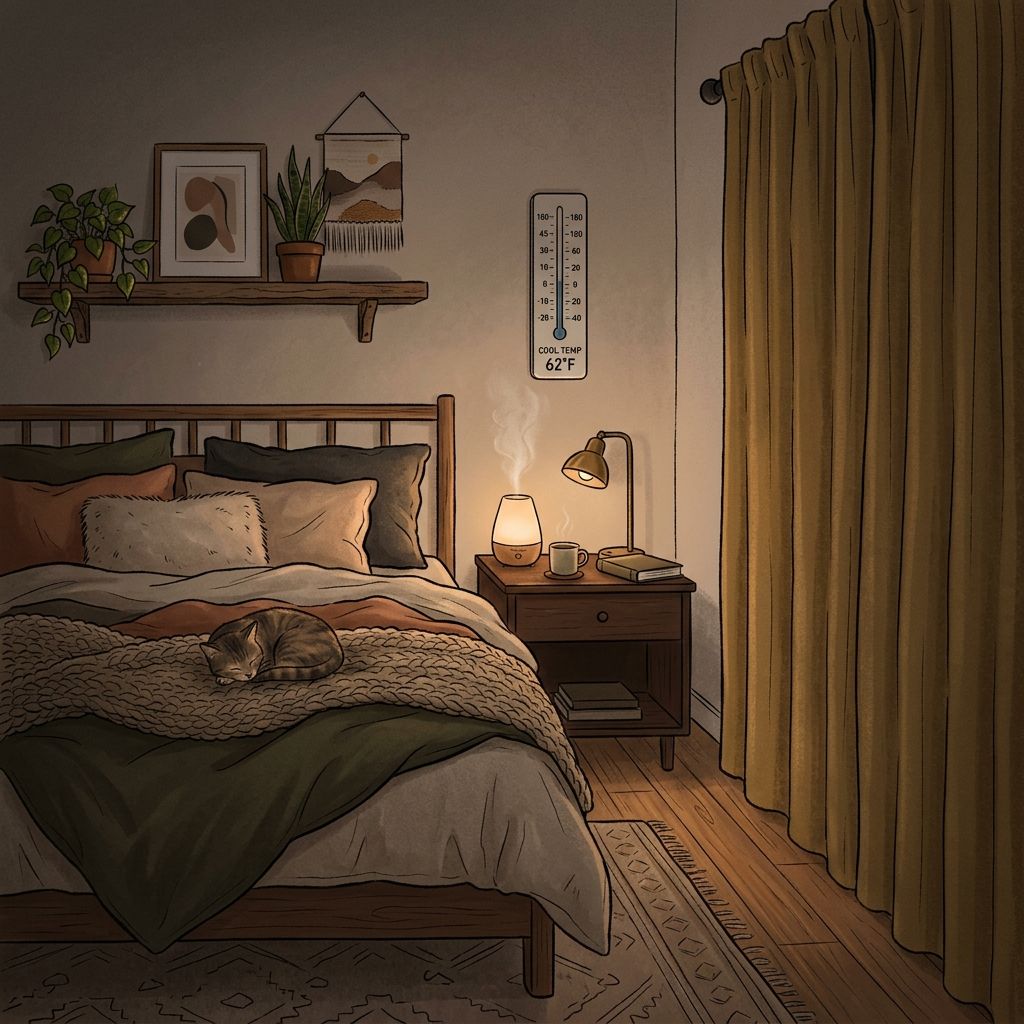
Feel like you clearly sleep for a long time, but the next day is still like you didn’t sleep? Waking up in the morning with a groggy head and eyes too heavy to open?
Many times, the problem is not your body, but your bedroom.
Your bedroom might be silently destroying your deep sleep, but you are completely unaware of it.
Why is the Bedroom Environment So Important?
In the process of evolution, the human brain developed a strict “safety check mechanism.”
Before falling asleep every night, the brain quickly scans the surrounding environment to confirm “is it safe here, is it suitable to let down guard”.
| Brain’s Judgment | Environment | Result |
|---|---|---|
| Environment Safe | Dark enough, cool enough, quiet enough | Start deep sleep programs, fully repair the body |
| Environment Threatened | Too bright, too hot, bad air | Only allow light sleep, ready to wake up and run away at any time |
Your brain won’t tell you “the room is too bright so I won’t let you sleep deeply”, it will only make you feel “as if you didn’t sleep” the next day.
Below we take you step-by-step to detect bedroom environmental factors to find out who is stealing your deep sleep.
Step 1: Assess Light
Light is the strongest signal for the brain to judge “whether it is day or night.”
Is Your Room Really Dark Enough?
Do a simple test before going to bed tonight: turn off all lights, lie in bed and wait for 3 minutes to let your eyes adapt to the darkness, and then see if you can see your own hand.
| Test Result | Meaning |
|---|---|
| Cannot see hand at all | Congratulations, your light environment is passing |
| Can vaguely see outline | There is a tiny amount of light leaking in, the brain might be slightly disturbed |
| Can clearly see fingers | Serious light pollution, melatonin secretion is being suppressed |
Common Sources of Light Pollution
You might think “just a little bit of light” is nothing, but the brain’s sensitivity to light is beyond imagination:
| Light Source | Impact |
|---|---|
| Street lights or signs leaking through curtain gaps | Even with eyes closed, the photoreceptor cells under the eyelids still receive light signals |
| Device indicator lights (chargers, air purifiers, TV standby red dots) | These small light points become exceptionally glaring in a fully dark room |
| Phone screen notification flashes | A single flash in the middle of the night is enough to trigger a micro-arousal, interrupting your ongoing deep sleep cycle |
Improvement Methods
| Method | Description |
|---|---|
| Switch to blackout curtains | Not ordinary dark curtains, but special blackout curtains with a silver coating on the back that can achieve 99% light blockage |
| Use black electrical tape to cover device indicator lights | Don’t underestimate this action; the results will surprise you |
| Turn phone face down or place it outside the bedroom | If you need an alarm clock function, buy a traditional alarm clock that does not glow |
| Switch all house lights 1 hour before sleep | Replace the main living room light with a dim warm yellow desk lamp to signal to the brain in advance that “it is dark” |
Step 2: Assess Temperature
There is a very direct relationship between your core body temperature and your ability to enter deep sleep.
Is Your Room Temperature Passing?
To enter deep sleep, the human body’s core temperature must drop by 1-1.5°C.
If the room is too hot, it is difficult for the body to dissipate heat, core temperature cannot drop, and the brain will judge that “it is not suitable for deep sleep now.”
| Bedroom Temperature | Evaluation |
|---|---|
| 18-20°C | Most ideal, the brain can quickly initiate deep sleep |
| 20-22°C | Passing, most people can sleep well |
| 23-25°C | High, deep sleep time will be significantly shortened |
| 25°C or above | Danger zone, you might be lightly sleeping and tossing and turning all night |
Why is "Using a Blanket While Running Air Conditioning" Scientifically Backed?
This behavior, which makes many people feel is a waste of electricity, actually perfectly meets the brain’s needs:
Air conditioning makes the room temperature drop to the range the brain needs, while the blanket keeps the skin surface feeling comfortable.
The core temperature felt by the brain is dropping, but your limbs won’t wake up from being cold.
Improvement Methods
| Method | Description |
|---|---|
| Set AC to 22-24°C | Combine with a thin blanket or cooling blanket |
| Take a hot bath 90 minutes before sleep | Hot water makes blood flow to the skin surface to dissipate heat; after bathing, the core temperature will rapidly drop, accelerating sleep |
| Wear socks on feet to sleep | Let the distal blood vessels dilate, accelerating core heat dissipation |
Step 3: Assess Air Quality
This is the part most people ignore, yet it might be the key to why you “sleep but feel unslept.”
Do You Breathe Through Your Nose or Mouth When Sleeping?
Pay attention tomorrow morning after waking up: if your mouth is dry and throat is a bit sore, you likely breathed through your mouth all night.
| Breathing Method | Impact on Sleep |
|---|---|
| Nose Breathing | The nasal cavity filters, humidifies, and warms the air, producing nitric oxide to help blood vessels dilate, leading to higher blood oxygen concentration |
| Mouth Breathing | Air enters lungs untreated, snoring probability increases, blood oxygen drops → brain hypoxia → micro-arousal frequency spikes |
Mouth breathing is one of the most common causes of "nighttime micro-hypoxia."
Because of hypoxia, the brain spends the whole night struggling to breathe again, and simply cannot enter repair mode.
Room CO₂ Concentration
If you are used to sleeping with doors and windows tightly shut, by the middle of the night the indoor CO₂ concentration might have soared to a level that makes you groggy.
| CO₂ Concentration | Impact |
|---|---|
| 400-600 ppm | Normal, good air quality |
| 600-1000 ppm | Start to feel stuffy, deep sleep time decreases |
| 1000 ppm or above | Obviously groggy, micro-arousal frequency increases significantly |
Improvement Methods
| Method | Description |
|---|---|
| Ventilate for 30 minutes before sleep | Even if you close windows and run AC later, this 30-minute air exchange can greatly reduce nighttime CO₂ levels |
| Use an air purifier | If outdoor noise is too loud to open windows, use an air purifier to keep indoor air circulating |
| Address nasal congestion | If nose is blocked due to allergies or deviated septum, solve nasal congestion first to improve mouth breathing |
| Try mouth tape | There are lip tapes specially designed for sleep; gently sticking lips can guide nose breathing (please consult a doctor first if nasal congestion is severe) |
Step 4: Assess Bed and Sleep Posture
You spent a third of your life lying on that bed; does it really suit you?
Pillow Height
A pillow is not "the softer the better" or "the higher the better."
| Pillow Problem | Impact | Result |
|---|---|---|
| Too high | Compresses trachea and carotid artery, narrowing airway | Snoring and hypoxia |
| Too low | Head lower than heart, blood rushes to head | Waking up with head swelling, high eye pressure |
| Material too soft, lacking support | Neck spine loses natural curvature, neck and shoulder muscles work all night | Waking up with a sore neck |
The correct pillow height keeps your spine in a straight line when lying on your side, and chin slightly lower than forehead when lying on your back.
Mattress Firmness
| Mattress Problem | Impact | Result |
|---|---|---|
| Too soft | Body sinks in, lumbar spine lacks support, tossing and turning with backache at night | Micro-awakening |
| Too hard | Pressure concentrates on shoulders and hips, pressure point pain | Tossing and turning |
Your Bedroom Environment Checklist
Go through these four assessments and score your bedroom using the table below:
| Assessment Item | Passing Standard | Your Status |
|---|---|---|
| Light | Cannot see hand after turning off lights | Passing / Failing |
| Temperature | Bedroom temperature maintained at 18-22°C | Passing / Failing |
| Air | Nose breathing, CO₂ below 1000ppm | Passing / Failing |
| Bed | Suitable pillow height, sufficient mattress support | Passing / Failing |
You don’t need to solve everything at once. Address the worst-performing item first, and you’ll often feel a significant improvement in sleep quality.
Give your bedroom a checkup: change to blackout curtains, adjust the AC temperature, and get rid of those faint indicator lights on devices.
Creating a dedicated sleep zone where the brain truly feels "safe" is the first step to reclaiming your energy.