Every morning you wake up with eyes swollen like a goldfish and a puffy face?
Or you slept for 7-8 hours but feel even more exhausted the moment you get up than before you went to bed?
This may not be because you didn’t sleep enough — it could be that your sleep posture is the problem.
The position you lie down in directly determines whether your breathing is unobstructed throughout the night.
When breathing is obstructed, the brain becomes oxygen-deprived. When the brain lacks oxygen, deep sleep cannot occur.
How Do You Usually Sleep?
Think back: how do you lie down every night?
Most people’s sleep postures fall into three categories:
| Sleep Posture | Airway Condition | Effect on Sleep |
|---|---|---|
| Back sleeping | Tongue base falls back due to gravity, easily blocking the throat | High snoring risk, large micro-hypoxia risk, reduced deep sleep |
| Side sleeping | Airway physically remains open | Smooth breathing, stable blood oxygen, increased deep sleep time |
| Stomach sleeping | Cervical spine over-rotates, compressing unilateral blood vessels | Neck soreness, arm numbness, not recommended for long-term use |
If you tend to sleep on your back and your partner often says “You were snoring so loudly last night,” your sleep quality is almost certainly being severely disrupted.
The “Micro-Hypoxia” Crisis of Back Sleeping
The biggest problem with back sleeping is gravity.
When you lie on your back, the tongue and soft palate collapse toward the throat due to gravity. It’s like a door slowly closing, turning your airway from a highway into a country road.
Mild Obstruction: Snoring
Air can barely get through, but the passage has narrowed. Air creates vibrations as it passes through the narrow gap.
That vibrating sound is snoring.
Snoring is not just a noise problem — it means your airway is being partially blocked.
Severe Obstruction: Sleep Apnea
If the tongue base collapses completely, the airway is completely blocked and air cannot pass at all.
Your body then enters emergency mode:
blood oxygen levelsdrop rapidly → the brain detects danger → forcibly wakes you up.
You may not remember waking up, because these micro-arousals usually last only a few seconds — you’ll shift slightly, take a deep breath, and fall back asleep. But the brain’s deep sleep cycle has already been interrupted.
| Severity | Micro-arousals per Hour | How You Feel |
|---|---|---|
| Normal | 0-5 times | Wake up feeling refreshed |
| Mild | 5-15 times | Wake up a bit tired, but manageable |
| Moderate | 15-30 times | Wake up with a heavy head, puffy eyes, drowsy during the day |
| Severe | 30+ times | Feel like you never slept, severely reduced concentration |
Why Can Side Sleeping Save Your Sleep?
The physical advantage of side sleeping is very clear: when you lie on your side, the tongue and soft palate are no longer pulled directly by gravity and naturally shift to one side, keeping the airway open.
| Item | Back Sleeping | Side Sleeping |
|---|---|---|
| Airway width | Compressed by tongue base, noticeably narrowed | Physically remains open |
| Snoring frequency | High | Greatly reduced |
| Nighttime blood oxygen | Prone to dropping and fluctuating | Stably maintained in normal range |
| Deep sleep proportion | Reduced by micro-arousals | Noticeably increased |
Research also finds that side sleeping (especially left-side sleeping) promotes the waste-clearance efficiency of the brain’s lymphatic system.
The brain activates a “cleansing” process during deep sleep, clearing metabolic waste that accumulated during the day, and side sleeping makes this clearing process more efficient.
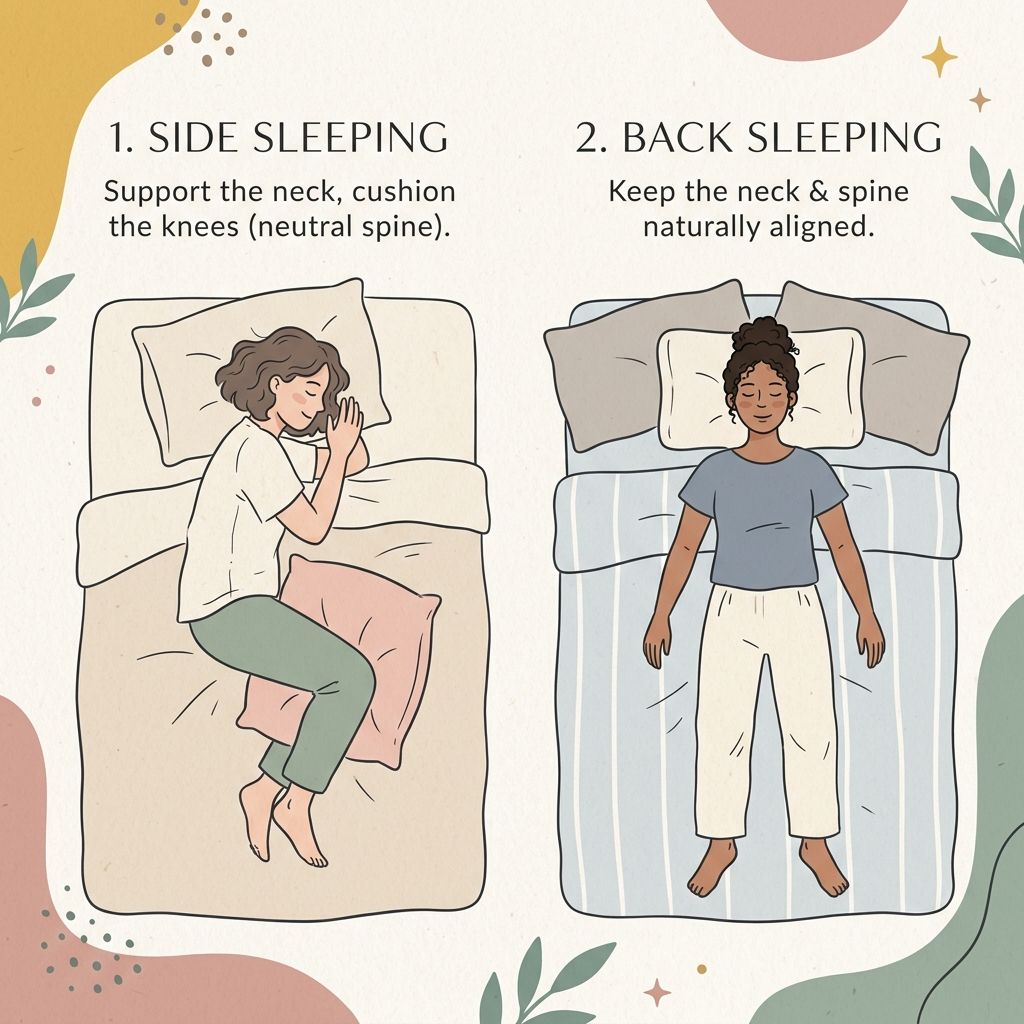
Want to Side-Sleep but Keep Rolling Back?
Many people know side sleeping is better, but unconsciously roll back to back sleeping after falling asleep.
This is because your body hasn’t yet established a new “sleep posture memory.”
Place a long body pillow between your knees. This simple action stabilizes the pelvis position, making it harder for the body to roll over after falling asleep.
| Pillow Technique | Effect |
|---|---|
| Between the knees | Stabilizes pelvis, prevents unconsciously rolling to back sleeping |
| Hugging against chest | Increases stability and sense of security while side sleeping, keeps shoulder from being suspended |
| Behind the back | Even if you try to roll, you’ll be blocked, forcing side sleeping |
Pillow Height: More Important Than You Think
Many people spend a lot of money on a good mattress, then use any random pillow.
A pillow’s function isn’t just to make you “comfortable lying down” — its core task is to keep your cervical spine in its natural curve and your airway open.
Pillow Too High
| Problem | Consequence |
|---|---|
| Chin pushed toward chest | Airway squeezed and narrowed, increased snoring and hypoxia risk |
| Cervical spine over-flexed forward | Neck muscles tense all night, waking up with neck soreness |
| Trachea compressed | Reduced airflow, you’ll unconsciously open your mouth to breathe |
Pillow Too Low
| Problem | Consequence |
|---|---|
| Head lower than heart | Blood rushes to the head, waking up with puffy eyes, high eye pressure, heavy head |
| Increased acid reflux risk | When lying flat, stomach acid more easily reaches the esophagus, waking you up choking |
| Cervical spine loses support | Spinal misalignment, neck muscles compensate with extra effort |
How to Tell If Your Pillow Height Is Right?
| Test Method | Pass Standard |
|---|---|
| While side-lying | Viewed from behind, head, neck, and spine form one straight line, ears and shoulders vertically aligned |
| While lying on back | Chin slightly lower than forehead (about 15 degrees), no feeling of labored breathing |
If when you lie on your side you find your head “sinking into” or “propped up on” the pillow, the pillow doesn’t suit you.
Mouth Breathing: The Most Overlooked Sleep Killer
Have you ever noticed that when you wake up in the morning, your mouth is dry and your throat is a bit sore?
If so, you’ve likely been breathing through your mouth all night.
Nasal Breathing vs. Mouth Breathing
| Item | Nasal Breathing | Mouth Breathing |
|---|---|---|
| Air filtration | Nose hairs and mucous membranes filter dust and bacteria |
No filtration, air enters the trachea directly |
| Air humidification | Nasal cavity automatically humidifies and warms air | Dry, cold air directly irritates the throat |
| Nitric oxide | Nasal cavity produces NO, dilates blood vessels, improves blood oxygen |
Cannot produce NO |
| Snoring risk | Low | High (mouth open → jaw recedes → airway narrower) |
Mouth breathing makes your airway more prone to collapse, lowers blood oxygen levels, and increases micro-arousal frequency.
Mouth breathing is the most common and most overlooked cause of nocturnal micro-hypoxia.
How to Improve?
| Method | Description |
|---|---|
| First rule out nasal congestion causes | If you have nasal congestion due to allergic rhinitis or deviated septum, please see a doctor first |
| Try mouth tape | There are low-adhesive lip tapes designed specifically for sleep; lightly adhering them to the lips guides nasal breathing (those with severe nasal congestion should see a doctor first — do not force use) |
| Practice nasal breathing before sleep | Lying in bed, close your mouth and slowly inhale through your nose for 4 seconds, exhale for 6 seconds, repeat 5 times, letting your body remember the rhythm of nasal breathing |
Small Changes Bring Big Improvements
You don’t need to buy any expensive equipment or undergo complex examinations.
Adjustments you can try tonight:
| Adjustment | How to Do It | Expected Effect |
|---|---|---|
| Switch from back to side sleeping | Place a long body pillow between your knees | Reduce snoring, improve blood oxygen, increase deep sleep |
| Adjust pillow height | When lying on side, confirm head, neck, and spine are in a straight line | Reduce neck compression, smoother breathing |
| Improve mouth breathing | Try mouth tape or pre-sleep nasal breathing exercises | Improve nighttime blood oxygen, reduce micro-arousal frequency |
Usually after making adjustments, within 3-5 days you’ll notice a difference: your eyes won’t be as puffy in the morning, that heavy feeling in your head will lighten, and your daytime energy will clearly improve.
Don’t underestimate these seemingly simple physical adjustments — your brain is deciding every night, based on breathing, temperature, and light, “should I enter deep sleep tonight?”
Give your body an environment where it can breathe well, and it will reward you with a clear-headed, refreshed morning.