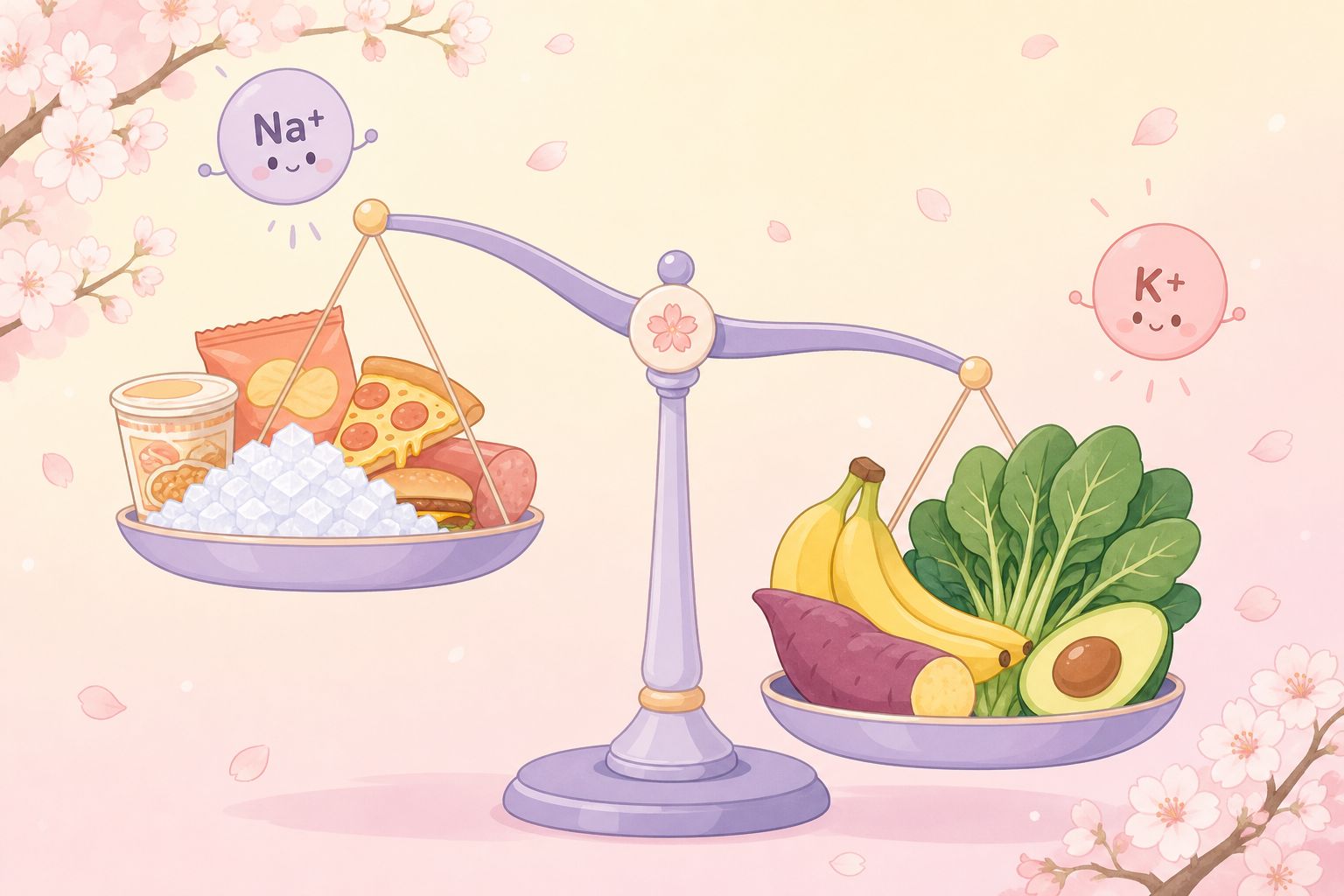
Eating too salty makes you thirsty, and eating bananas can prevent cramps. The science behind these common life facts is actually related to the sodium and potassium in our bodies.
These two tiny minerals act like a seesaw in the body, and problems will arise whether one side is too high or too low.
- Too much sodium, the blood vessels are stretched to the limit;
- Too little potassium, the body doesn’t even have the ability to excrete excess sodium.
What Roles Do Sodium and Potassium Play in the Body?
To understand how to control them, let’s first look at their respective roles.
sodiumis responsible for “water retention”, andpotassiumis responsible for “water drainage”.
| Ion | Main Function | What If Too Much? | What If Too Little? |
|---|---|---|---|
| Sodium | Maintains blood pressure, transmits nerve signals | Water retention, edema, increased blood pressure | Dizziness, cramps, and in severe cases, coma (hyponatremia) |
| Potassium | Helps muscle contraction, excretes excess sodium | Slow heart rate, arrhythmia (hyperkalemia) | Muscle weakness, constipation, night cramps |
At the cellular level,
sodiumandpotassiumoppose each other.
There is a mechanism called the sodium-potassium pump on the cell membrane. When you supplement enough potassium, the body will actively exchange the sodium in the blood vessels out, excreting it with urine, and blood pressure will naturally drop.
Why Is the Sodium-Potassium Seesaw in Modern People Imbalanced?
The problem lies in the dietary habits of modern people, which tilt this seesaw severely.
The eating-out population easily consumes excess sodium, but insufficient potassium-rich fruits and vegetables.
Hidden High-Sodium Traps in Eating Out
| Food Type | Why is sodium content high? |
|---|---|
| Hot Pot Soup Bases and Sauces | Shacha sauce, chili paste, and soy paste are the hardest-hit areas of sodium |
| Processed Flour Products | Noodles, toast, and bread have a lot of salt added during making to increase chewiness |
| Instant Noodles and Ready-to-Eat Foods | The sodium content in the seasoning packets often exceeds the recommended daily intake |
| Pickled Foods | Pickled mustard greens, preserved fruits, and fermented bean curd are all high-sodium foods |
Many people say “I don’t usually feel salty when eating,” but these foods are actually “non-salty high-sodium foods.”
Your tongue is deceived, but your blood vessels bear the real pressure.
What Signals Does the Body Send When Sodium-Potassium Is Imbalanced?
| State | Body’s Reaction |
|---|---|
| Too much sodium, too little potassium | Prone to edema (puffy eyelids in the morning, tight shoes in the afternoon), frequent fatigue, and elevated blood pressure |
| Too little potassium | Calf cramps in the middle of the night, general muscle weakness, and constipation |
How to Adjust the Seesaw Back to Balance?
Adjusting the sodium-potassium balance doesn’t require weighing food with an electronic scale, just master the principles of “reducing sodium and supplementing potassium”.
Reducing Sodium: Controlling the Mouth to Relieve Blood Vessel Pressure
| Practice | How to Execute |
|---|---|
| Half the Sauce | When eating dumplings or hot pot, dip lightly with chopsticks instead of pouring the whole dish |
| Only a Few Sips of Soup | Drink only 2-3 sips of ramen or hot pot soup to taste, and leave the rest in the bowl |
| Check Nutrition Labels | Look at the sodium content when buying convenience foods, aiming for no more than 800 mg per meal |
Supplementing Potassium: Let Fruits and Veggies Help You Excrete Excess Sodium
Taiwan has many easily available high-potassium ingredients, no need to buy expensive imports:
| Category | Recommended Ingredients |
|---|---|
| Vegetables (Every Meal) | Water spinach, sweet potato leaves, spinach, amaranth, bamboo shoots, enoki mushrooms |
| Fruits (As Snacks) | Guava (first choice for high potassium and low sugar), banana, kiwi, cherry tomatoes, papaya |
| Roots Replacing White Rice | Sweet potato, potato, taro. High potassium, high fiber, low GI |
| Natural Drinks | Sugar-free red bean water (drink only water without eating beans), black coffee, sugar-free soy milk |
The core of the DASH Diet is high potassium, low sodium, and plenty of fruits and vegetables.
How to Keep Potassium Ions in Food?
Potassium has a characteristic: highly soluble in water.
This means the way you cook vegetables will directly affect how much potassium you consume:
| Your Goal | Suitable Target | Cooking Method | Reason |
|---|---|---|---|
| To consume more potassium | General population, hypertension patients | Stir-fry, or cook the vegetable broth into soup and drink it together | Potassium dissolves in water, so drinking soup helps ingest the potassium |
| To reduce potassium intake | Kidney patients | Cut vegetables into small pieces, blanch in boiling water for 3-5 mins, and discard the water completely | Can remove more than 50% of the potassium from vegetables |
Why Can’t Kidney Patients Consume High-Potassium Foods at Will?
A high-potassium diet is good for general people and hypertension patients, but it is not suitable for everyone.
People with impaired kidney function may find eating too much high-potassium food to be fatal.
Why Should Kidney Patients Be Extra Careful?
Healthy kidneys are extremely powerful; even if you eat too much potassium, it will be completely excreted in the urine within a few hours.
But when kidney function declines to a certain level, the kidneys’ ability to excrete potassium is greatly reduced.
If such patients blindly eat high-potassium foods, potassium ions will surge in the blood, leading to hyperkalemia.
Hyperkalemia will directly interfere with the electrical conduction of the heart, leading to arrhythmia, and in severe cases, the heart will suddenly stop beating.
Dietary Precautions for Kidney Patients
| Precautions | Reason |
|---|---|
| Do Not Use Low-Sodium Salt | Commercial low-sodium salt replaces sodium chloride with potassium chloride, which is like taking poison for kidney patients |
| Do Not Drink Vegetable or Hot Pot Soup | These concentrated broths are “high-potassium water” with extremely high potassium content |
| Do Not Drink Freshly Squeezed Juice | Juice concentrates the potassium of fruits into a cup, putting a heavy burden on kidneys |
| Blanch Veggies Before Stir-frying | Blanch in boiling water first to remove most of the potassium before cooking and eating |
| Do Not Eat Starfruit | Starfruit contains a neurotoxin that kidney patients absolutely cannot eat |
How Can a Day’s Sodium-Potassium Balance Be Arranged?
No need to measure with a scale daily, just implement a few simple replacements in life:
| Meal | How to Eat for Eating-Out Folks | How to Do for Home-Cooking Folks | Vascular Care Mindset |
|---|---|---|---|
| Breakfast | Sandwich + sugar-free soy milk | Oatmeal + fresh milk + sliced banana | Both soy milk and banana supplement potassium |
| Lunch | Buffet: white rice + one fish dish + two plates of green vegetables | Brown rice + stir-fried sweet potato leaves + pan-fried fish | Vegetables supplement potassium, fish supplements Omega-3 |
| Afternoon Tea | Buy a guava from a convenience store | Homemade sugar-free red bean water | Natural potassium supplement to combat afternoon fatigue |
| Dinner | Dry noodles (less sauce) + bamboo shoot soup | Baked sweet potato + stir-fried loofah with mushrooms + salt-grilled Pacific saury | Melons and mushrooms are high-potassium, low-calorie ingredients |
身体的健康,往往藏在这些微小的平衡里。
少沾一点酱油、多夹两口青菜,就是在帮身体的钠钾翘翘板找到最完美的平衡點。