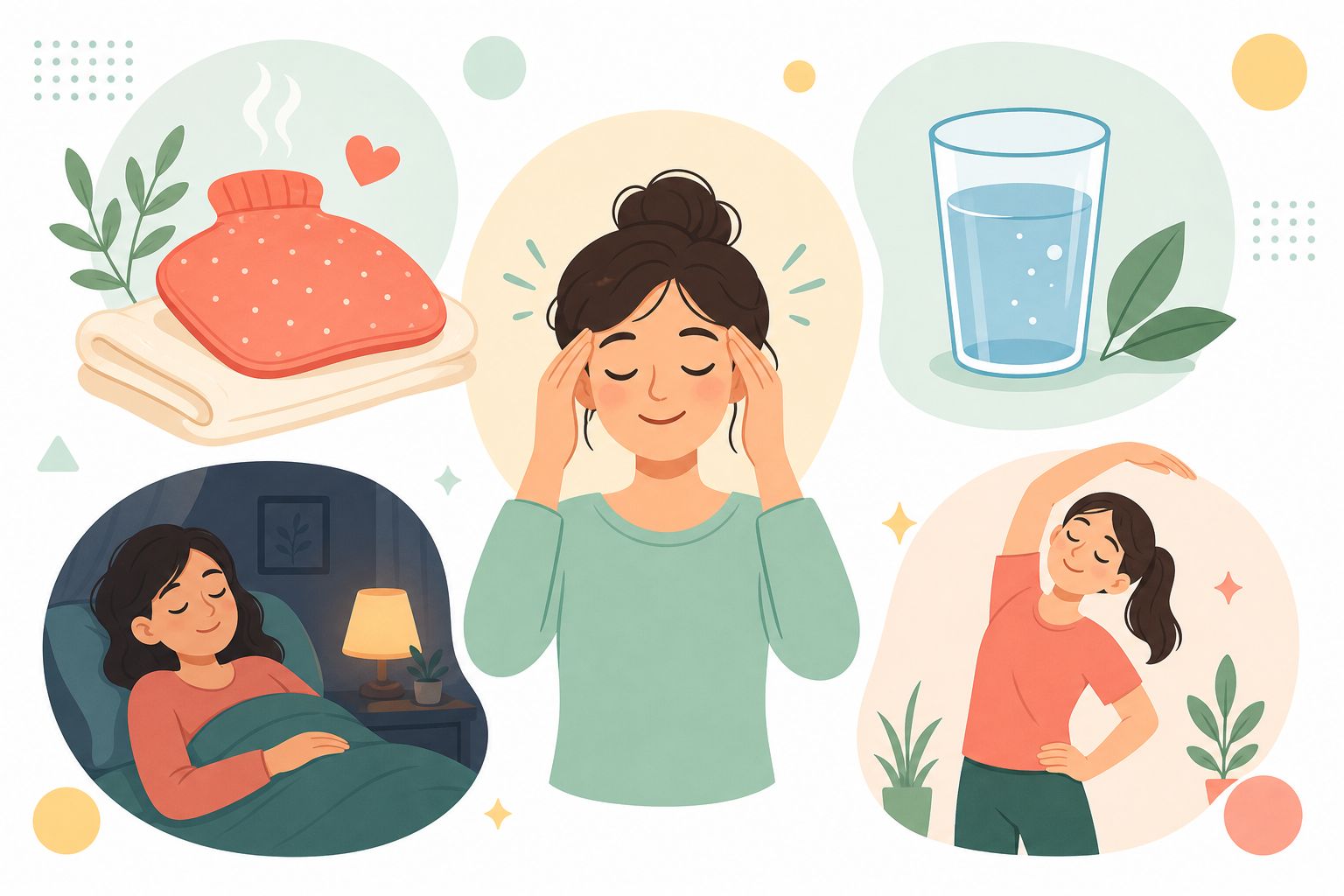
Everyone has experienced a headache, and that feeling as if your head is about to explode is truly unbearable.
Working all day with a stiff neck and shoulders, staring at a screen for too long with sore eyes, or even not sleeping well the night before—a headache can suddenly come knocking just like that.
When a headache strikes, what else can we do besides reaching for pain relievers? And what are the danger signals that absolutely cannot be delayed?
Practical Methods for Headache Relief
For the most common tension headaches (caused by tight neck and shoulder muscles) and fatigue-induced headaches, there are actually a few drug-free tips to relieve the pain:
Hot and Cold Compresses: Choose the Right Method Based on the Pain Type
| Headache Type | Recommended Method | Reason |
|---|---|---|
| Tension Headache | Hot compress on neck, shoulders, and back of the head | Relaxes tight muscles and fascia |
| Migraine | Cold compress on forehead or temples | Reduces the throbbing sensation caused by local vasodilation |
A simple way to judge: If your pain is a tightness like the whole head is being squeezed, try a hot compress; if it is throbbing on one side, a cold compress is usually more comfortable.
Stay Away from Stimuli: Give Your Brain a Quiet Environment
Headache发作时,你的大脑处在 过度敏感 的状态。
Bright lights, loud noises, and blue light from phone screens will all multiply and amplify your discomfort.
Find a quiet, dark space and close your eyes to rest for 15 to 30 minutes—this is often much more efficient than pushing through and continuing to work.
Hydrate and Get a Moderate Amount of Caffeine
Have you ever noticed that after being busy all day and forgetting to drink water, your head starts to throb in the afternoon?
Mild dehydration is an easily overlooked cause of headaches. When the body lacks water, blood flow to the brain decreases, triggering a pain alarm. Try slowly drinking 300 to 500 ml of room-temperature water and observe for 20 minutes to see if there is improvement.
A moderate amount of caffeine can also help slightly constrict blood vessels, which has a certain soothing effect in the early stages of a migraine. However, note the word “moderate”—a cup of black coffee is enough. Drinking too much will make you even more sensitive.
Acupressure and Stretching
Using your thumbs to press the Fengchi acupoint (GB20, the depressions on both sides of the hairline at the back of the head) and the Hegu acupoint (LI4, the highest point of the tiger’s mouth) for 30 seconds to 1 minute each time can help relieve tension in the head, neck, and shoulders.
Combined with gentle neck stretches, slowly tilting your head to both sides will produce even better results.
Pain Relievers Are Not a Cure-All: Taking Them Wrong Makes It Worse
Taking pain relievers is the fastest way to relieve pain, and that is fine. But did you know? The timing and frequency of taking them is the real key.
Best Timing for Taking Medication
Pain relievers are best taken as soon as you start to feel a headache coming on. Waiting until you are sweating from intense, unbearable pain to swallow a pill will usually significantly reduce its effectiveness.
This is because once the pain signals are “amplified” to a certain level in the nervous system, simple pain relievers will have a hard time pressing them back down.
“Medication Overuse Headaches” Are Very Real
If you take pain relievers for more than 10 to 15 days per month, your body may develop a paradoxical reaction where the medicine meant to stop the pain actually becomes the cause of the headache.
| Scenario | Risk |
|---|---|
| Taking pain relievers more than 15 days a month | Highly likely to trigger medication overuse headaches |
| Taking them 10 to 14 days a month | Already in the warning zone |
| Taking them less than 10 days a month | Normal range of use |
This condition is medically known as Medication Overuse Headache (MOH), which can turn occasional headaches into a daily painful struggle.
If you find yourself becoming increasingly reliant on pain relievers, please talk to a doctor about alternative solutions.
Understand Which Category Your Headache Belongs to First
Most headaches people experience do not have a clear “medical cause” and are medically classified as primary headaches.
| Classification | Definition | Common Types |
|---|---|---|
| Primary Headache | The headache itself is the disease, not caused by other conditions | Tension headache, Migraine, Cluster headache |
| Secondary Headache | The headache is a “symptom” of another disease | Headaches caused by brain hemorrhage, meningitis, or brain tumor |
Primary headaches account for more than 90% of all headaches. Although uncomfortable, they are usually not life-threatening.
So why do we need to specifically mention secondary headaches? Because although they are rare, they can be alarms sounded by serious conditions like brain hemorrhages, infections, or tumors.
And the difference between the two sometimes cannot be determined just by how much it hurts; what you need to pay attention to are other symptoms accompanying the headache.
ER Immediately
If your headache matches any of the following, please drop everything and seek immediate medical attention:
“Thunderclap Headache”: Pain That Explodes Suddenly
Reaching the most severe headache level of your life within seconds to a minute, as if something exploded in your head. This condition, known as a Thunderclap Headache, may indicate a subarachnoid hemorrhage or a ruptured brain aneurysm—every minute is a race against time.
Headache Accompanied by “Neurological Symptoms”
If your headache is accompanied by any of the following conditions, it means something serious might be happening in your brain:
- Sudden weakness or numbness in your hands or feet
- Slurred speech or inability to speak
- Blurred consciousness, drowsiness, or difficulty waking up
- Sudden vision deterioration or double vision
- Unsteady gait or inability to stand
Headache Accompanied by Signs of Infection
Fever + Headache + Stiff neck—the simultaneous appearance of these three is a classic manifestation of meningitis and requires emergency treatment.
Special Considerations for Age and Medical History
| Condition | Description |
|---|---|
| Experiencing a severe headache for the first time after the age of 50 | Need to rule out possibilities like temporal arteritis or tumors |
| Cancer patients developing a new pattern of headaches | Need to rule out brain metastasis |
| Ongoing, worsening headache after a head injury | Could be a subdural hemorrhage |
These situations are not things you can just “wait and see.”
It is better to go to the ER and find out it was a false alarm than to miss the golden window of treatment.
Don’t Treat All Headaches Lightly, and Don’t Scare Yourself Every Time
The most practical attitude toward headaches is:
Learn self-soothing methods while knowing when to call for help.
Most of the time, a glass of water, a quiet rest, or medication taken at the right time is all it takes to get you back to your normal rhythm.
But if your headache is a sudden explosive pain, carries neurological symptoms, or is combined with fever and a stiff neck, then don’t tough it out—let professional medical staff make the call.
Relax when it’s time to relax, and seek medical attention decisively when needed. Take good care of your head so it can continue to work well for you.