
Sometimes we fall into an extreme state: our intellect is desperately telling us to pull ourselves together, yet our body feels locked up and unable to move, and our brain goes completely blank.
Is this really just because of our weak willpower?
When the Brain Is Sick: What Is “Psychomotor Retardation”?
In psychiatry, this state of “wanting to move but being unable to” is called Psychomotor Retardation. It is common in major depressive disorder, manifested as frozen physical energy and a noticeable slowing of thoughts and movements.
| Dimension of Manifestation | Specific Condition |
|---|---|
| Cognitive Sluggishness | Slowed reaction time, stagnant thinking, difficulty concentrating, as if the brain has become dull |
| Motor Sluggishness | Slowed limbs and gait, and even speech rate and volume decrease |
| Lack of Motivation | Extreme fatigue and weakness, prolonged bed rest, loss of interest in surroundings |
| Extreme Stupor | In severe cases, one may be completely unable to move voluntarily, showing a “stupor” state |
Patients will feel as if their
brainhas entered an energy-saving mode, making even small tasks like getting out of bed or taking a shower extremely difficult.
This Is Not Your Weak Willpower; It’s a Disconnect of Signals in the Brain
The most important concept is: this is not you being “lazy” or “not strong enough,” but rather a protective and withdrawal mechanism of the brain.
When the brain faces chronic stress or trauma, the activity of areas controlling emotion and movement (such as the basal ganglia, motor cortex, and limbic system) decreases, leading to a deficiency of neurotransmitters like dopamine and serotonin.
When the concentration of these chemical substances responsible for transmitting motor signals is too low, the efficiency of the brain issuing commands becomes extremely poor.
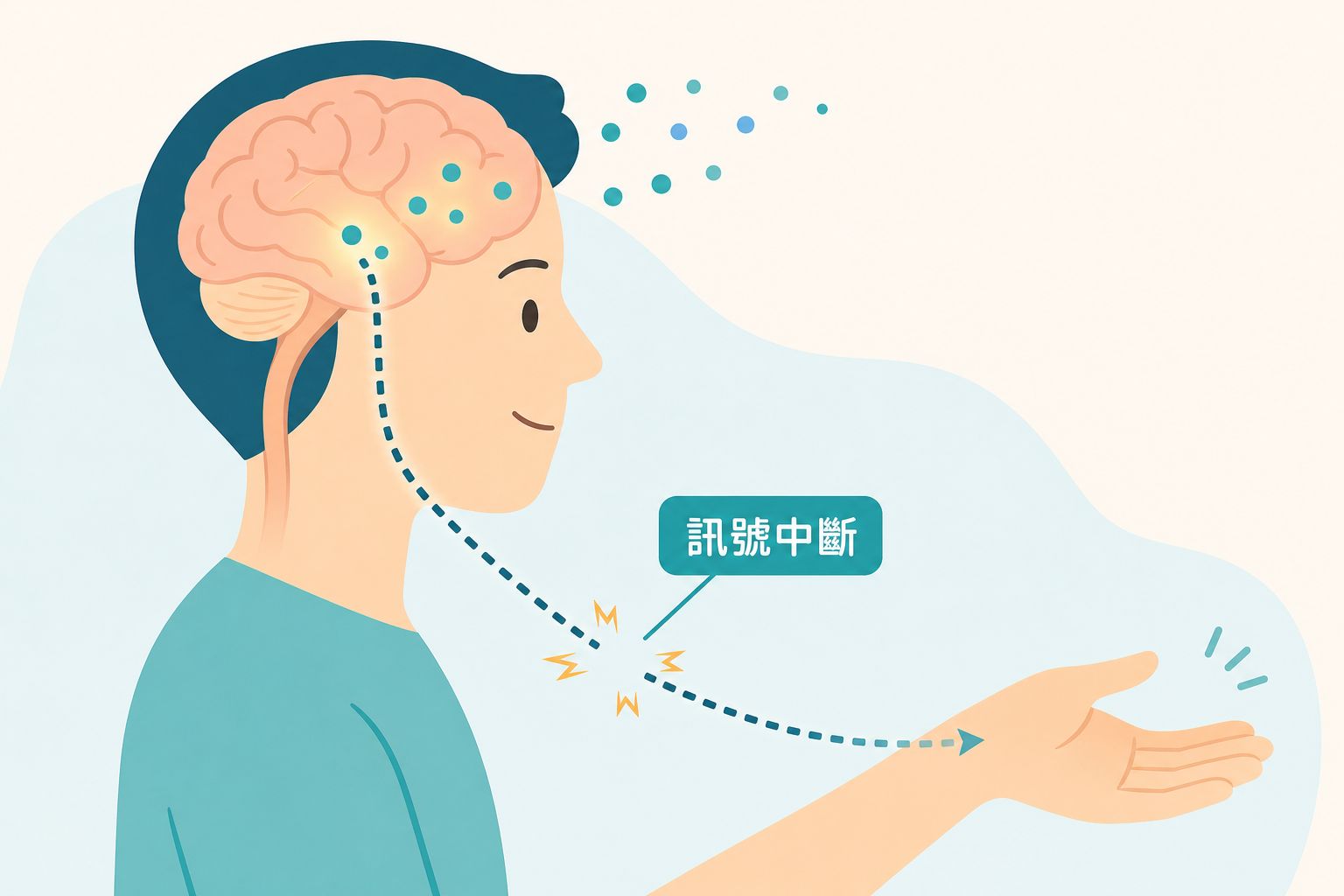
Your intellect wants to move, but your body doesn’t receive the commands; this is the result of neurotransmitter imbalance, not your fault.
The underlying reason why you “intellectually want to move, but your body cannot receive the command” is a problem with the transmission of neural signals, not that you are not trying hard enough.
Objectifying this can help you feel less self-blame. This is a physiological phenomenon with scientific backing, not a personal character defect.
When Should You Seek Medical Help?
Occasional low moods or being tired for a while can usually be relieved by rest. However, if this “forced shutdown” state lasts for more than two weeks and cannot be improved by rest at all, or if even getting up to shower is difficult, it may be a warning sign of major depression or chronic fatigue syndrome.
If you find that in addition to being unable to move, you also experience the following conditions, it is recommended to consult a psychiatrist or seek psychological counseling.
| Warning Sign | Description |
|---|---|
| Severe Sleep Disorder | Extreme sleepiness (hypersomnia), or all-night insomnia, early morning awakening |
| Anhedonia | Unable to feel a shred of joy from interests you used to love |
| Intense Worthlessness | Strong feelings of guilt, feeling like you can’t do anything right |
| Lasting for More Than Two Weeks | The above conditions exist long-term, and rest cannot relieve them |
Asking for help is not weakness, but the most important step to recovery.
If you suspect you or someone around you has these symptoms, seek a professional doctor’s assessment as soon as possible.
A Mental Cold Also Requires Seeing a Doctor
There is no need to feel ashamed of your state.
Just as the body can fracture or catch a cold, the brain, of course, can also get sick.
A mental cold also requires seeing a doctor. Seek professional help from psychiatry at the right time. Through medication to regulate neurotransmitters, combined with cognitive behavioral therapy, you can break the vicious cycle of “not wanting to move → worsening physical fitness → feeling even more depressed.”
Let professionals accompany you to reboot your brain; you don’t have to carry it all alone.