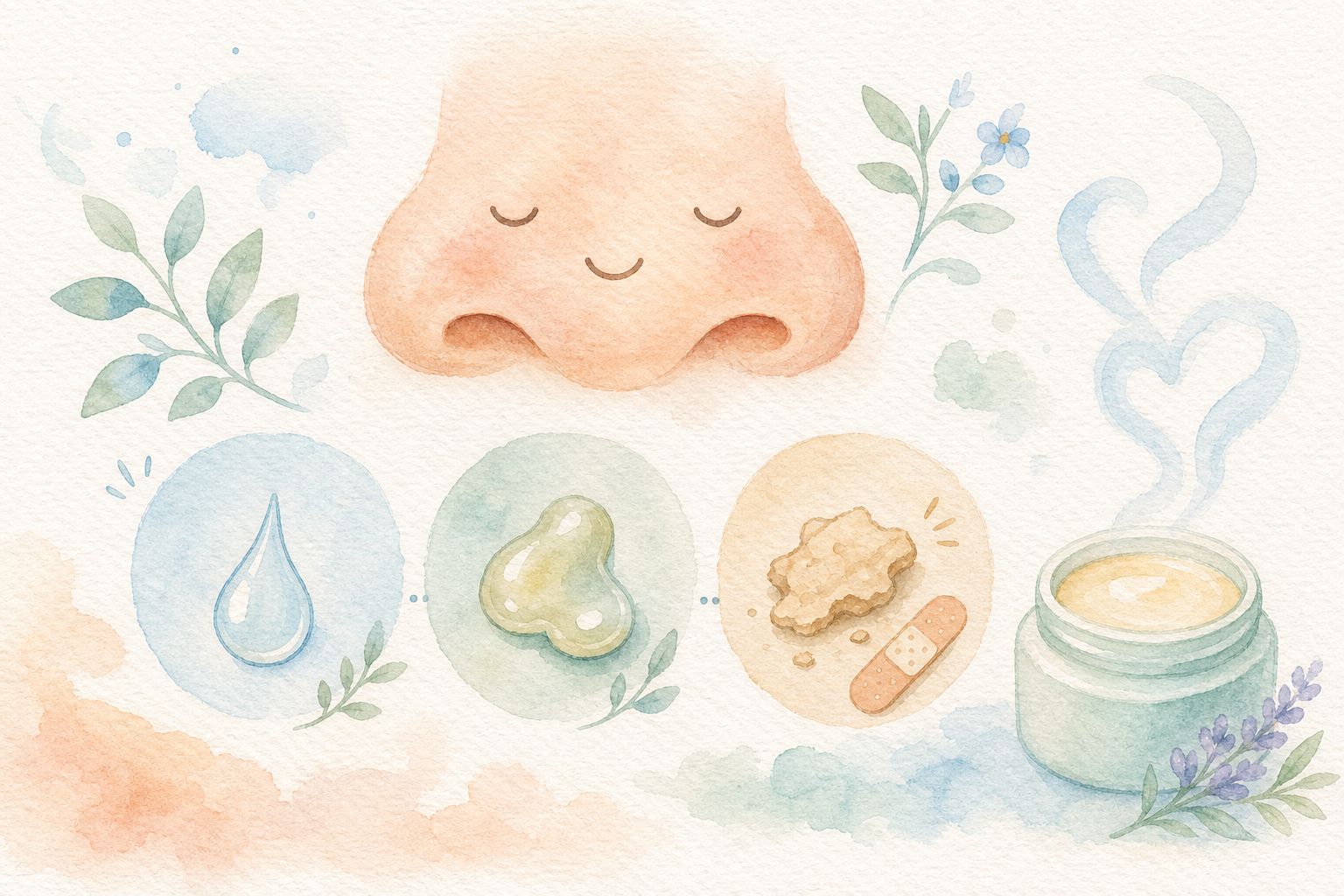
Sometimes runny nose drips like a faucet, and other times it turns into hard scabs stuck in your nose.
What’s worse is that when you pick it, it actually bleeds.
What do these things mean? In fact, it all has to do with nasal humidity and the fragility of microvessels.
Why is snot sometimes watery and other times thick?
Even though it’s all snot, the texture is so different because the “added ingredients” inside are different.

Snot is about 95% water, and the remaining 5% is the key that determines the texture, including mucin, immune cells, and external dirt.
| Texture | What the body is doing |
|---|---|
| Watery snot | Physical rinsing. Microvessels dilate rapidly, water leaks out frantically, and there is no time to add mucin, so it flows like tap water |
| Thick mucus | Cleaning the battlefield. Inflammation stimulates glands to secrete a large amount of mucin, plus the accumulation of dead white blood cells and cell debris makes it thick |
Watery snot is the body rinsing, while thick snot is the body fighting and cleaning the battlefield.
mucin is like self-made glue of human body, with large molecules and a great love for absorbing water. When water evaporates and the proportion of mucin increases, snot becomes thicker.
How do sticky boogers actually form?
Sticky boogers are actually the result of snot acting as “flypaper”.
Your nose is inhaling dust, exhaust gas, dander, and bacteria 24 hours a day. After these dirt particles are stuck by the mucin in the snot, the breathing airflow keeps blowing over them, evaporating most of the water.
After the originally watery snot concentrates and condenses, it becomes like clay, feeling sticky like normal boogers.
Therefore, boogers are not dirty things causing trouble, but a protective byproduct of the nasal cavity packaging dirt.
What are those hard scabs in the nose?
When you feel something hard like a shell stuck to the nasal wall, and it hurts to pick it off, it is usually not just boogers, but actual blood scabs.
It’s like when you scrape your knee, a hard scab forms after a few days, except this wound is inside your nose.
There is an area at the front of the nasal cavity called Kiesselbach's plexus, where the mucous membrane is extremely thin but packed with dense microvessels.
When the weather is too dry, in air conditioning, or during allergies, the mucous membrane becomes dry and shriveled. Just rubbing your nose or blowing your nose hard will cause microvessels to bleed slightly.
This tiny amount of blood mixes with snot and quickly dries under the blowing dry airflow, becoming a hard scab tightly adhered to the mucous membrane.
Why does picking a scab cause a nosebleed?
This is the most common cause of nosebleeds, medically called mechanical trauma, which simply means physically tearing open a wound.
It gets stuck in a vicious cycle:
| Step | What happens |
|---|---|
| 1. Dry cracking and bleeding | The nasal cavity is too dry, and microvessels rupture and bleed slightly |
| 2. Coagulation and scabbing | Blood and boogers dry up, tightly adhering to the fragile mucous membrane |
| 3. Picking it out | Feeling a foreign body sensation and unable to resist picking it, tearing off the underlying membrane that is about to heal |
The moment you force the scab off, it’s like tearing open a healing wound again, causing the underlying microvessels to instantly bleed heavily again.
To break this devil’s triangle, the key is not to pick it hard, but to use gentle methods instead:
| Method | Explanation |
|---|---|
| Soften with hot steam | Take deep breaths of hot steam during a shower to let the hard scab absorb water, and a light blow will make it fall off naturally |
| Apply Vaseline to moisturize | Use a cotton swab to apply a little Vaseline to the inner wall of the nostrils to lock in moisture and block dirt, so the wound won’t easily scab again |
Treat your nasal cavity well, quit the habit of picking it
Don’t underestimate snot and boogers; they actually reflect the humidity and health status of the nasal cavity.
Watery, thick, and scabbed, behind all of them is the body rinsing, fighting, or repairing.
As long as you moisturize well, quit the habit of picking your nose, and use hot steam and Vaseline for gentle cleaning, you can restore a healthy protective net to the nasal cavity and avoid bleeding unnecessarily.