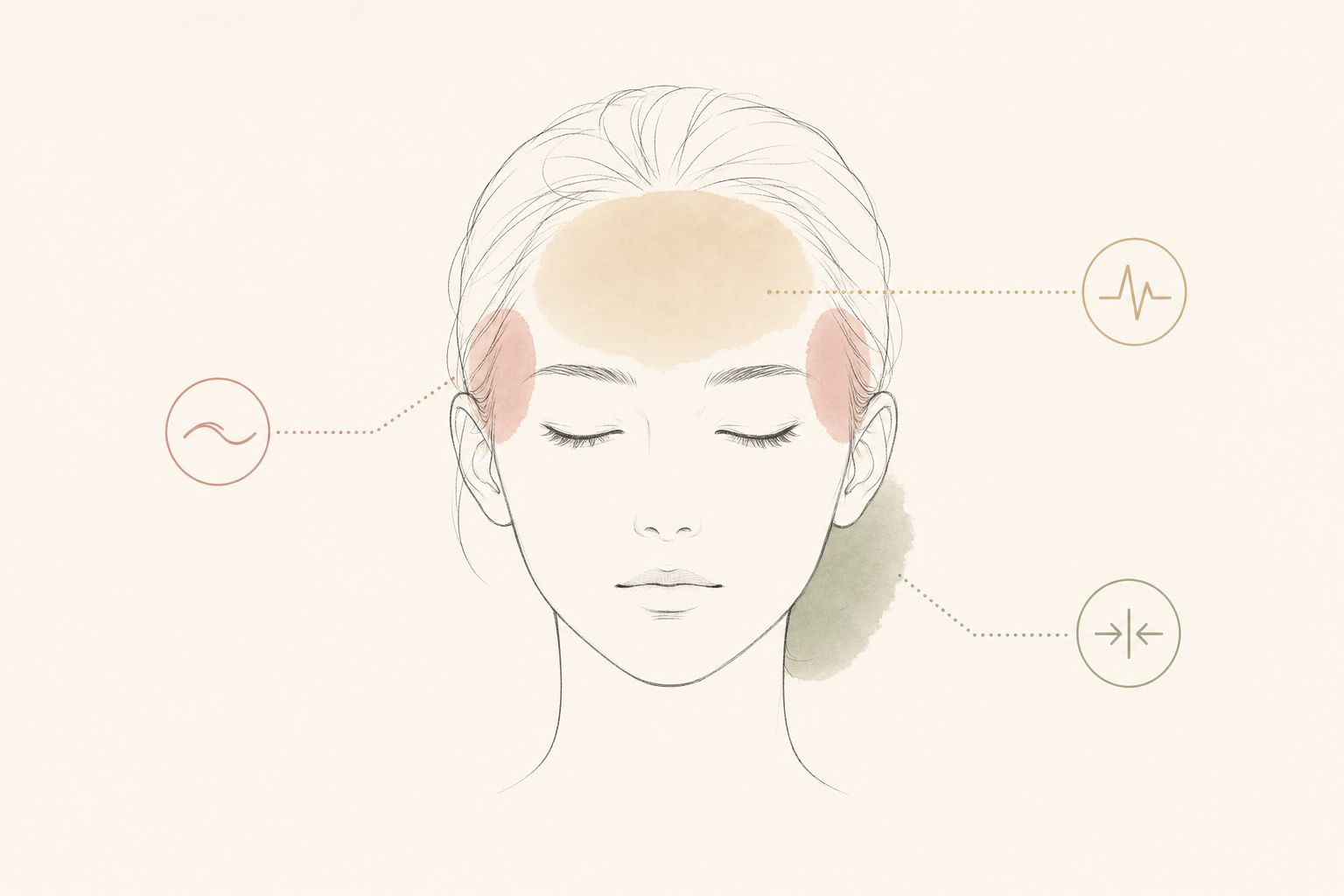
Is your temple throbbing, the back of your head tight, or does your whole head feel like it’s wearing a tight headband? Have you noticed that the location of your headache seems to be different every time?
In fact, you can preliminarily determine which type of headache you have simply from “where it hurts.”
Different Locations, Different Headache Types
There are many types of headaches, but the locations where they strike often follow a pattern. By dividing headaches roughly into three areas, it will be much easier for you to identify yours.
Tightness in the Whole Head or Back of the Head: Tension Headache
This is the most common type of headache, experienced by about 70% of people.
It feels as if an invisible band is wrapped around your forehead to the back of your head, squeezing your entire head tightly. The pain is described as a dull, pressing ache rather than a throbbing pain that pulses like a heartbeat.
| Feature | Description |
|---|---|
| Location | The entire head, especially the back of the head and both temples |
| Sensation | A pressing sensation like being tightly wrapped in a bandage |
| Intensity | Mild to moderate, usually does not affect daily activities |
| Common Triggers | High stress, lack of sleep, staring at screens for too long, tight neck and shoulder muscles |
Tension headache, while not extremely severe, is so common that its cumulative impact on quality of life should not be underestimated.
Throbbing Pain on One or Both Sides: Migraine
The name migraine is slightly misleading because it doesn’t necessarily only hurt on one side.
A typical migraine features a throbbing pain that pulses like a heartbeat, and it often comes along with a group of accompanying symptoms.
| Feature | Description |
|---|---|
| Location | Mostly starts at one temple and sometimes spreads to the entire head |
| Sensation | Throbbing pain, like blood vessels pulsing |
| Intensity | Moderate to severe, making you just want to lie down and not move |
| Accompanying Symptoms | Nausea, vomiting, sensitivity to light, sensitivity to sound |
| Duration | Lasts from 4 to 72 hours |
Some people experience a phenomenon called an “aura” about 20 to 60 minutes before a migraine attacks, such as sudden flashes of light, zigzagging bright lines, or temporary blind spots in their field of vision.
If you have experienced this, it is almost certain to be a migraine.
Severe Pain Around the Eye Socket: Cluster Headache
Cluster headache is relatively rare, but the level of pain is so extreme that it is nicknamed the “suicide headache.” Just the name alone tells you how agonizing it is.
| Feature | Description |
|---|---|
| Location | Concentrated in one eye socket or around the eye socket |
| Sensation | Like a red-hot iron nail piercing into the eye |
| Intensity | Extremely severe, making it impossible to stay still |
| Accompanying Symptoms | Tearing in the eye on the same side, conjunctival congestion, nasal congestion or runny nose, drooping eyelid |
| Duration | 15 minutes to 3 hours per episode, recurring repeatedly over several weeks |
Cluster headache has a peculiar pattern: it likes to strike at a fixed time, especially in the middle of the night or early morning, waking you up on time like an alarm clock.
Looking at Location Isn’t Enough? These Clues Are Also Key
Location is indeed a great starting point for identifying headache types, but it is not the only basis.
Migraines can sometimes hurt on both sides, and tension headaches occasionally concentrate on only one side. How can you distinguish them further? In addition to “where it hurts,” you should also combine these three observation dimensions.
What Does the Pain “Feel” Like?
| Pain Sensation | Possible Headache Type |
|---|---|
| Dull, pressing, like being squeezed | Tension Headache |
| Throbbing, pulsing like a heartbeat | Migraine |
| Sharp piercing, like being stabbed | Cluster Headache |
Are There Accompanying Symptoms?
This is often the most powerful clue to distinguish headache types.
| Symptoms | Possible Headache Type |
|---|---|
| Stiff neck and shoulders, pressure on both temples | Typical combination of tension headache |
| Nausea, sensitivity to light, sensitivity to sound | Almost a unique signature of migraine |
| Tearing on the same side, nasal congestion, facial sweating | Pointing towards cluster headache |
How Long Does It Last? How Often Does It Occur?
| Headache Type | Single Episode Duration | Attack Frequency |
|---|---|---|
| Tension Headache | 30 minutes to several days | Occasional or almost daily |
| Migraine | 4 to 72 hours | Several times a month |
| Cluster Headache | 15 minutes to 3 hours | Frequent attacks for several weeks, then disappearing for several months |
Putting the four dimensions of location + sensation + accompanying symptoms + temporal pattern together is like a jigsaw puzzle; the profile of your headache will become clearer and clearer.
Next Time You Have a Headache, Observe Before You Act
When a headache strikes, don’t rush to swallow pills. Take a few seconds to feel it:
Where does it hurt? How does it hurt? Are there any other sensations?
This will not only help you find a more suitable way to relieve it,
- A
tension headachemight be relieved by relaxing your neck and shoulders - A
migrainerequires resting quietly in a dark, quiet room
If you really need to see a doctor, these observation records can also provide more precise clues, helping you get rid of headache troubles sooner.
Your body is constantly talking to you through “pain.” Learning to understand its language is the very first step to taking care of yourself.