
Outside the emergency room or the ICU, hearing the doctor say “the patient needs to be intubated” often leaves many family members with a completely blank mind.
Does intubation mean it is hopeless?
Actually, this is a very common misunderstanding. Most of the time, intubation is a critical step to buy time for life.
What is Intubation Exactly? Why Put a Tube Down the Throat?
You can think of the human respiratory system as a logistics center:
Airis the cargo, thetracheais the shipping lane, and thealveoliare the warehouses responsible for unloading and delivering oxygen to the blood.
Endotracheal intubation is when this logistics center gets stuck. A doctor inserts a tube through the mouth directly into the trachea to help the patient send oxygen straight to the lungs.
There are two main situations that cause the logistics center to get stuck, which many people often confuse:
| Situation | Where is the problem | Analogy |
|---|---|---|
| Airway obstruction | The channel for air is blocked | The shipping lane is blocked by collapsed cargo |
| Respiratory failure | The channel is clear, but gas exchange cannot be completed | The channel is clear, but the warehouse is broken and cannot unload cargo |
Intubation does not cure the disease itself; it first stabilizes the vital lifeline of breathing to buy time for the medical team to treat the underlying illness.
When is Intubation Needed? Four Common Timings
It doesn’t mean that a patient must be intubated just because their condition is severe. Doctors will judge whether a patient needs this lifesaving tube in the following situations:
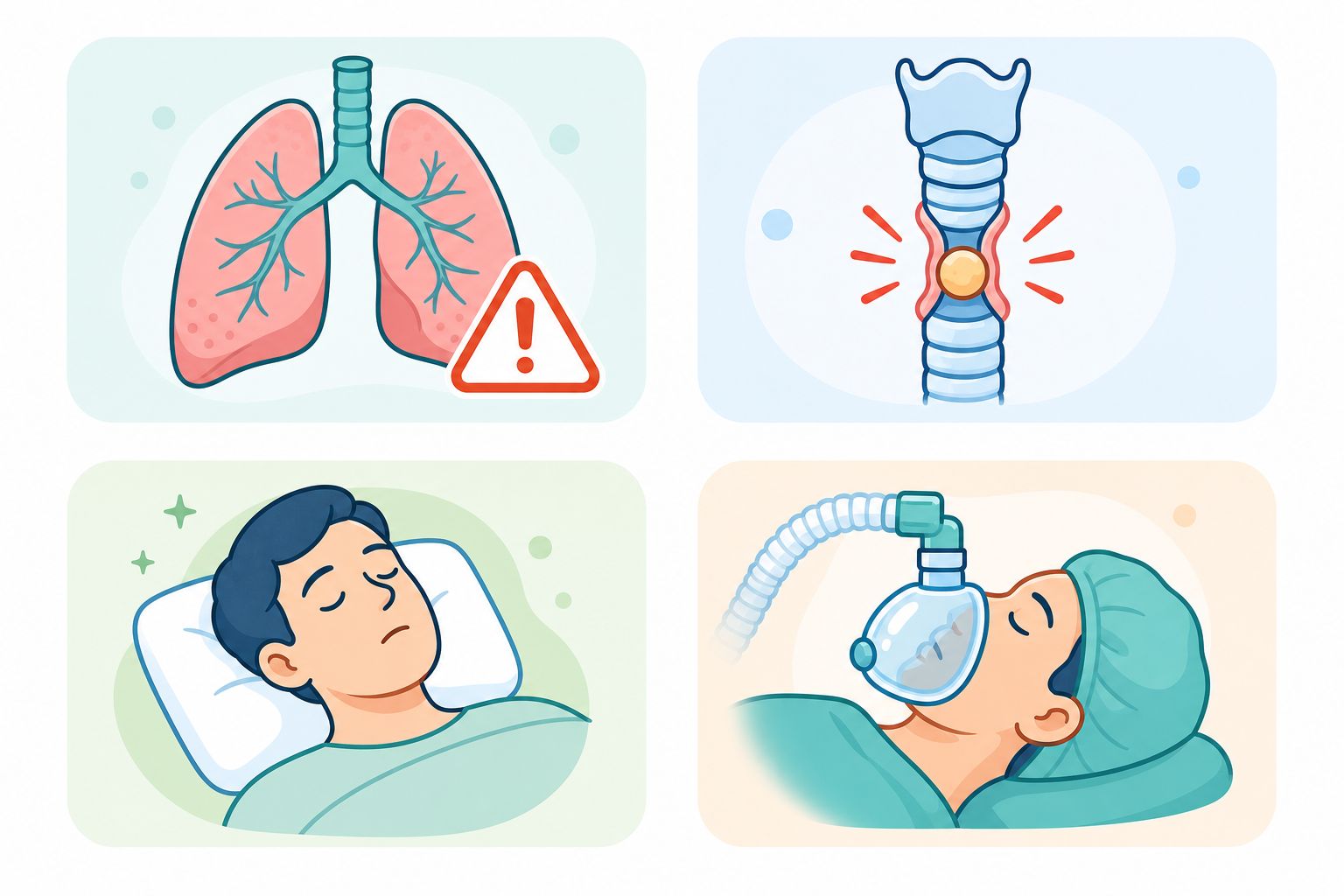
| Timing | Typical Scenario | Why Intubation is Needed |
|---|---|---|
| Respiratory failure | Severe pneumonia, pulmonary edema | The lungs cannot complete gas exchange on their own, and blood oxygen continues to drop |
| Airway obstruction | Choking on foreign objects, severe trauma swelling | The air channel is blocked, and a clear artificial airway needs to be established |
| Loss of consciousness and reflexes | Stroke, brain injury, coma from drug poisoning | Cough and swallow reflexes are lost, and saliva or vomit may be aspirated into the lungs |
| Major surgery under general anesthesia | Open chest, open abdomen, and other major surgeries | Anesthetic drugs will temporarily stop spontaneous breathing, which must be handled by a ventilator |
Why is Intubation So Uncomfortable? What Challenges are Faced During Intubation?
Although intubation can save lives, it is definitely not a comfortable process for a conscious patient. A foreign object passing all the way from the mouth through the throat into the trachea is understandably highly uncomfortable.
The most common question from family members is:
Why can’t my intubated loved one talk to me?
| Challenge | Reason |
|---|---|
| Inability to speak | The balloon of the tube is fixed at the vocal cords, preventing airflow from passing through the vocal cords, so no sound can be made |
| Intense foreign body sensation | The throat is stretched open by the tube, causing constant urges to cough and swallow, which is extremely distressing |
| Need for sedation and restraint | To prevent patients from unconsciously pulling out the tube, mild sedation and hand restraints are often necessary |
| Switching to nasogastric tube feeding | The mouth is occupied by the tube, making eating impossible; nutrition is supplied via a nasogastric tube |
Seeing their loved one restrained and unable to speak is often very painful for family members.
Restraint is not a punishment, but a measure to protect patients from pulling out the tube when they are not fully conscious, which could cause greater harm.
Why Can’t Intubation Drag On for Too Long?
If it is so uncomfortable, can we just leave the tube in and wait slowly for the patient to get better? The answer is no.
Long-term intubation causes real physical damage:
- Prolonged friction from the tube can cause damage and scarring to the throat and tracheal mucosa
- Oral bacteria can easily slide down the tube, causing ventilator-associated pneumonia
- With breathing handled by the machine long-term, respiratory muscles will gradually atrophy and become weak
This is why doctors view intubation duration as a key observation index.
When Can the Tube Be Removed? What Obstacles Must Be Passed for Extubation?
Since intubation is a temporary bridge, once the bridge is crossed and the underlying illness improves, the tube should naturally be removed.
However, extubation is not done on a whim; doctors must first confirm that the patient has the ability to breathe on their own and protect their own airway. Usually, three stages must be passed:
| Extubation Stage | Key Assessment |
|---|---|
| Improvement of the primary disease | For example, pneumonia is controlled, and blood oxygen remains stable |
| Clear consciousness | The patient can be awakened, understands commands, and can cooperate with coughing up sputum |
| Adequate respiratory muscle strength | Passing ventilator weaning trials, showing spontaneous breathing strength is sufficient to support them |
Ascending to the core question of extubation:
Once this tube is removed, can the patient breathe safely on their own?
What If the Tube Can Never Be Removed?
Most people can successfully undergo extubation and resume normal breathing after their primary disease is treated. However, some patients’ conditions are more complex, and they struggle to get off the ventilator.
If the intubation duration lasts for more than 2 to 3 weeks and weaning is still not possible, leaving it in will only increase throat damage and infection risks.
At this point, doctors usually recommend a tracheostomy as a “stop-loss point” for a long-term battle.
A tracheostomy is not a declaration of giving up; it is switching to a more comfortable and safer breathing channel to give the patient the strength to continue recovery.
Returning to the very first question: intubation is not the end of life, but a temporary bridge.
As long as the primary disease on the other side of the bridge is treated, most people can walk across this bridge, successfully undergo extubation, and breathe freely again.