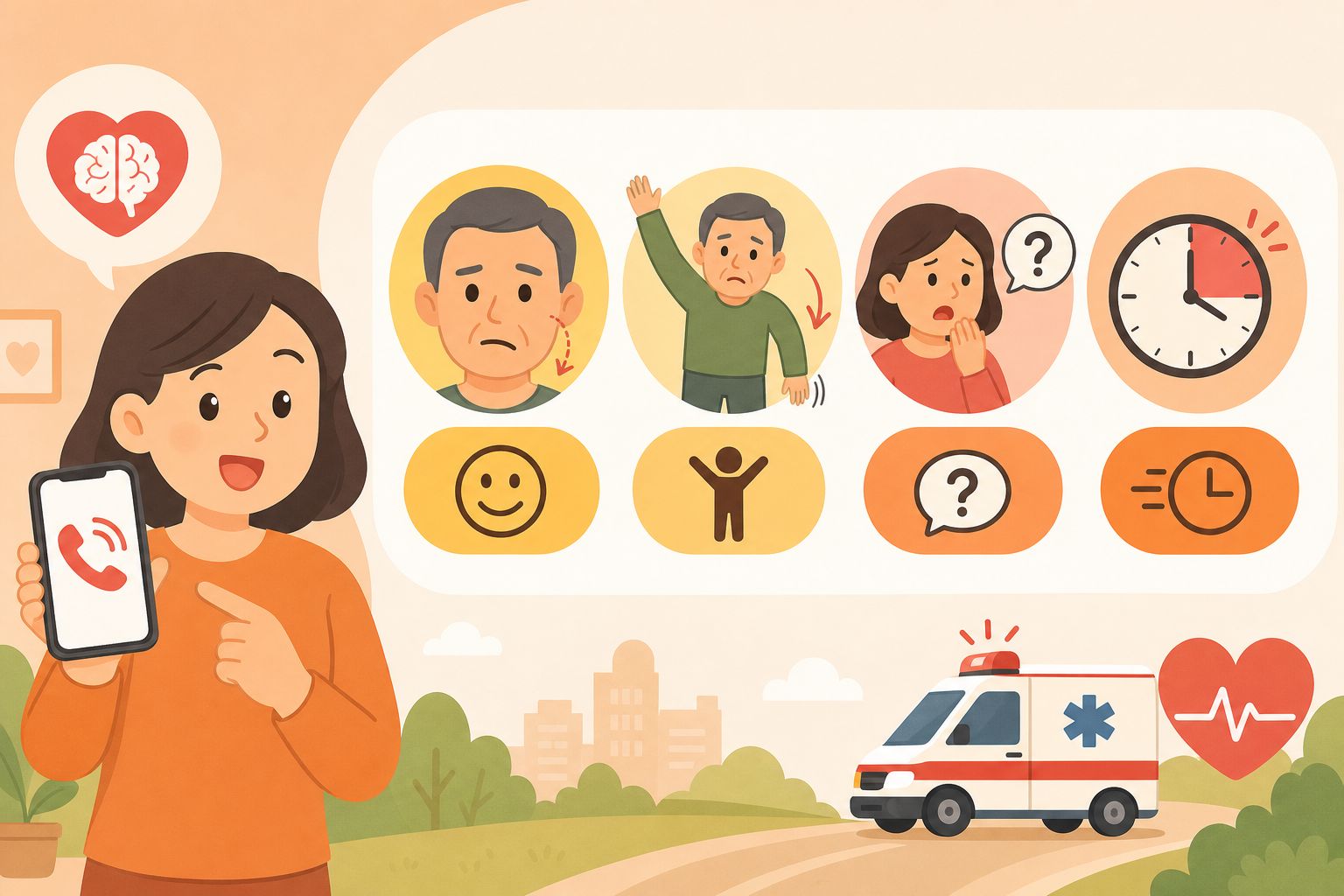
What would you do if a family member next to you suddenly couldn’t even say a simple “Hello” clearly?
During a stroke, every single minute of delay costs the brain approximately 1.9 million brain cells.
In a state of panic, many people make the wrong moves, such as feeding water, giving medicine, or even using a needle for bloodletting, which only pushes the situation into a more dangerous state.
Learning how to correctly recognize a stroke and dispelling fatal first-aid myths are life-saving skills that everyone should have.
What Warning Signs Does the Body Show When a Stroke Strikes?
The most prominent feature of a stroke is “suddenness”.
One second you are chatting and laughing, and the next second your body has a problem. The internationally recognized acronym for identification is FAST:
| Letter | English | Test Method | Key Observation |
|---|---|---|---|
| F | Face | Ask the person to smile | Check if both sides of the face are symmetrical, and if there is a drooping corner of the mouth on one side |
| A | Arm | Ask the person to raise both arms | Check if one arm drifts downward weakly |
| S | Speech | Ask the person to say “The weather is very nice today” | Check if they are slurring their words, or completely unable to speak |
| T | Time | Record the exact hour and minute symptoms appeared | Immediately call 119, and inform them of the onset time |
If any one of these three actions cannot be done, it is highly likely to be a stroke, and the patient must be sent to the hospital immediately.
Besides FAST, What Other Danger Signals Exist?
FAST can catch most strokes, but several other warning signs should not be ignored either:
| Signal | Explanation |
|---|---|
| Sudden numbness on one side of the body | Sudden loss of sensation on one side of the face, arm, or leg, unlike the feeling of a limb falling asleep |
| Sudden vision abnormalities | Sudden loss of vision in one eye, like a black curtain falling; or seeing double images |
| Sudden trouble walking | Staggering as if drunk, with difficulty even standing steadily |
| Explosive, severe headache | Unprecedented severe pain, like being struck by lightning, commonly seen in hemorrhagic stroke |
| Sudden difficulty understanding speech | Hearing is normal, but the brain seems to freeze and cannot comprehend what others are saying |
Can We Perform Bloodletting for a Stroke? Is Feeding Water or Medication OK?
When facing an emergency, elders often say “quickly prick the fingers with a needle for bloodletting” or “give them a blood pressure pill to swallow.”
These folk remedies are not only useless, but can also be fatal.
Three Fatal Myths
| Myth | Reality | Why It Is Dangerous |
|---|---|---|
| Pricking fingers to let blood clears blood vessels | Bloodletting cannot clear the blood clot inside cerebral blood vessels | Painful stimulation can make blood pressure spike even higher, accelerating the worsening of hemorrhagic stroke |
| Quickly feed water or food | The swallowing nerves might already be damaged during a stroke | Water and food can easily be choked into the lungs, leading to aspiration pneumonia or even suffocation |
| Administer blood pressure medicine on your own | During ischemic stroke, the brain intentionally raises blood pressure to save itself | Lowering blood pressure without authorization makes the brain more oxygen-deprived, and the damaged area expands instead |
Where Did the Saying of Bloodletting Come From?
From the perspective of Traditional Chinese Medicine, the technique of pricking fingers to let blood is called Shi Xuan Bloodletting, but it is not used for emergency rescue of stroke.
Shi Xuan Bloodletting uses stimulation of peripheral nerves to keep the patient awake. This is a medical procedure and should only be performed by a professional practitioner of TCM after determining it is an ischemic stroke.
For ordinary people to perform this at home, the risks far outweigh the benefits.
What Are the Correct Stroke Emergency Response Steps?
The only correct way is simple, but must be executed calmly and rapidly:
| Step | What to Do | Why It Matters |
|---|---|---|
| Step 1 | Immediately call 119 | Emergency medical personnel are on the ambulance and can notify the hospital’s Stroke Green Channel in advance to prepare |
| Step 2 | Precisely record “the last time they were seen normal” | The doctor needs this time to decide whether the life-saving drug can be administered |
| Step 3 | Place the patient on their side | Prevents vomit or the tongue from blocking the trachea to avoid suffocation |
| Step 4 | Loosen tight clothing like collars and neckties | Keep the airway unobstructed |
| Step 5 | Stay by their side and soothe their emotions | Anxiety will cause blood pressure to spike higher, worsening brain damage |
Do not feed anything, do not move the patient’s head, and do not drive to a small clinic on your own.
If you must transport the patient yourself, go directly to a large hospital equipped with stroke emergency response capabilities, do not waste time sending them to a general clinic.
Why Can “Recording the Time” Save a Life?
You might wonder, why is the last letter of the FAST acronym T (Time)?
Because the life-saving medicine for stroke has a strict time limit.
Time Decides What Weapons Doctors Can Use
| Treatment Method | Time Limit | Working Principle |
|---|---|---|
| Intravenous Thrombolytic Agent (rt-PA) | Within 4.5 hours of onset | Use drugs to dissolve the blood clot blocking the blood vessel |
| Arterial Thrombectomy | Within 6 to 24 hours of onset | Insert a catheter into the brain blood vessel to physically pull out the blood clot |
If the family cannot provide a clear time of onset, doctors do not dare to use the thrombolytic drug blindly, because administering it past the time limit will instead increase the risk of cerebral hemorrhage.
The “exact hour and minute” you record could be the only key to whether your family member can clear their blood vessels and save their brain cells.
What Happens After Reaching the Hospital?
The hospital will activate the Stroke Green Channel, and all examinations and treatments will be fast-tracked:
| Time | Explanation |
|---|---|
| 0-10 minutes | Nurses immediately measure blood sugar (to rule out hypoglycemia mimicking stroke), draw blood, and evaluate severity |
| 10-25 minutes | Urgent transfer to Computed Tomography (CT) to confirm if the blood vessel is blocked or ruptured |
| 25-45 minutes | The doctor decides on using a thrombolytic agent or thrombectomy based on CT results and onset time |
| Within 60 minutes | Administration of medication is completed, and the patient is transferred to the Stroke Intensive Care Unit for close monitoring |
The international medical standard strives to complete “Door-to-Needle” within 60 minutes.
If Symptoms Clear Up Quickly, Do I Still Need to See a Doctor?
There is a condition called “Mini-Stroke” (Transient Ischemic Attack, TIA).
The symptoms are exactly the same as a stroke, but they usually recover on their own within a few minutes to 24 hours.
Never assume that because you feel better, everything is fine.
A mini-stroke is the ultimate ultimatum sent by the brain. It means that the cerebral blood vessels are already severely narrowed or have unstable plaques, and the probability of a major stroke occurring in the future is extremely high.
Even if symptoms disappear within a few minutes, you must go to the emergency room immediately for a complete examination, allowing the doctor to evaluate the condition of the blood vessels and intervene early.
Facing a stroke, the best preparation we can make is to engrave the FAST acronym in our minds, and bravely say no to folk remedies.
At the critical moment, your calm judgment and that phrase “when it started” can save your family member’s brain and future.
Reference
- Stroke - Wikipedia
- Every 47 Minutes, 1 Person Dies of Stroke. Seize the Golden 3 Hours, Stroke is Controllable - Ministry of Health and Welfare
- Department of Neurology - Treatment of Ischemic Stroke - National Taiwan University Hospital
- Stroke Emergency Golden 3 Hours! Learn Stroke Emergency 4 Steps, Treatment Flow Once - Common Health Magazine