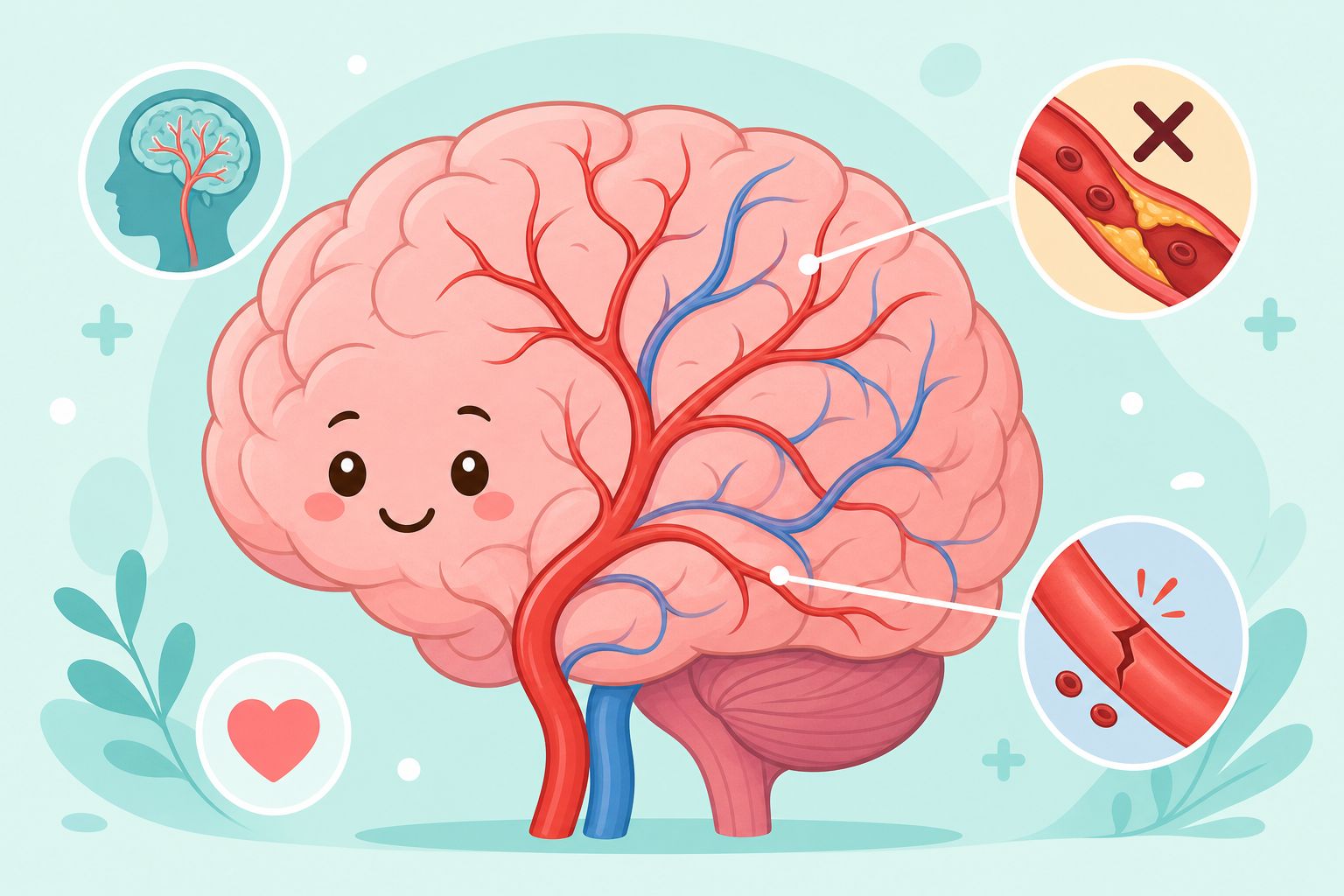
Imagine the brain’s control center, which usually runs smoothly, suddenly experiencing a ‘blackout’ due to a blocked or ruptured blood vessel.
One moment a person is perfectly fine, and the next, their limbs stop working and their speech becomes slurred.
This is what we commonly call a stroke.
Even if a life is saved, a stroke often leaves behind severe long-term disabilities.
But the good news is that up to 90% of strokes are linked to controllable risk factors. In other words, we have a chance to close the door before it strikes.
What is a Stroke? What is the Difference Between Ischemic and Hemorrhagic Stroke?
The medical term for a stroke is a cerebrovascular accident (CVA). In plain language, it means a blood vessel in the brain suddenly gets blocked or ruptures, causing:
Brain cells to be deprived of blood and oxygen supplies, beginning to die within just a few minutes.
Strokes are mainly divided into two major types:
| Type | Proportion | Cause | Everyday Analogy |
|---|---|---|---|
| Ischemic Stroke | Approx. 80% | The blood vessel is blocked by a blood clot, preventing blood flow | A water pipe clogged by debris |
| Hemorrhagic Stroke | Approx. 20% | The blood vessel ruptures and bleeds, compressing brain tissue | A water pipe bursting under too much pressure |
Regardless of the type of stroke, as long as
brain cells are deprived of oxygen for more than a few minutes, they will die, and dead brain cells cannot regenerate.
This is why the rescue speed for a stroke is so critical.
How to Recognize if Someone is Having a Stroke?
The biggest characteristic of a stroke is its “suddenness”.
One second they are laughing and talking, and the next, something is terribly wrong with their body.
There is an internationally recognized acronym for identifying a stroke called FAST:
| Letter | English | Action | Key Observations |
|---|---|---|---|
| F | Face | Ask the person to smile | Check if both sides of the face are symmetrical, and if one corner of the mouth is drooping |
| A | Arm | Ask the person to raise both arms | Check if one arm drifts downward weakly |
| S | Speech | Ask the person to repeat a simple phrase | Check if their speech is slurred or strange |
| T | Time | Note the time | Immediately call 119/911 for emergency help |
If a person fails even one of these three tasks, it is highly likely to be a stroke. Act immediately and call for help.
Besides FAST, What Other Stroke Warning Signs are Easy to Ignore?
- Sudden numbness on one side of the body, which is different from limbs falling asleep, but rather losing sensation in half of the body
- Sudden vision changes in one or both eyes, like a black curtain blocking the view
- Sudden trouble walking, losing balance and stumbling like being drunk
- A severe headache that comes out of nowhere, sometimes accompanied by projectile vomiting
- Sudden difficulty understanding what others are saying, or being unable to speak at all
What is the First Thing to Do When Someone Has a Stroke?
Many people’s first reaction when encountering a stroke is to feed the patient water, give them blood pressure medication, or even prick their fingers to let blood out.
All of these are extremely dangerous, incorrect behaviors.
What You Must Absolutely NOT Do
| Common Myths | Why It is Dangerous |
|---|---|
| Pricking fingers to let blood | Bloodletting cannot clear blood vessels, and the pain may actually cause blood pressure to spike higher |
| Feeding water or food | A stroke may impair swallowing function, and feeding can easily cause choking or aspiration pneumonia |
| Giving blood pressure medicine | During an ischemic stroke, the brain intentionally raises blood pressure to save itself; lowering it can make oxygen deprivation worse |
| Waiting to see if it gets better | For every 1 minute delayed, the brain loses about 1.9 million brain cells |
Correct Emergency Steps
- Immediately call emergency services (119/911) to get an ambulance.
- Accurately record the time when the patient was last seen normal (this is critical for doctors to decide if life-saving drugs can be used).
- Place the patient in a side-lying position to prevent vomit from blocking the airway.
- Loosen tight clothing around the collar or tie to keep the airway clear.
- Stay by the patient’s side to calm them down, letting them know that help is on the way.
How Do Doctors Treat a Stroke After Arriving at the Hospital?
Upon arrival at the hospital, doctors will initiate a stroke green channel, where all examinations and treatments are fast-tracked and prioritized.
Treatment Within the Golden Window
| Treatment | Applicable Condition | Principle |
|---|---|---|
| Intravenous Thrombolysis (rt-PA) | Within 4.5 hours of onset, Ischemic Stroke | Uses drugs to dissolve the blood clot |
| Endovascular Thrombectomy | Within 6 to 24 hours of onset, large vessel occlusion | Uses a catheter to go deep into cerebral vessels and extract the clot |
The earlier the blood vessel is opened, the more brain cells can be saved.
However, thrombolytic agents carry about a 6% risk of causing brain hemorrhage, so a doctor must conduct a thorough evaluation before use.
This is also why an accurate onset time is so important, because it directly determines whether the doctor can prescribe this life-saving drug.
Can You Recover from a Stroke?
Although dead brain cells cannot be brought back to life, the brain has an amazing ability called neuroplasticity.
Through continuous and repetitive rehabilitation stimulation, other healthy areas of the brain can ‘rewire’ to take over some of the lost functions.
It is like when a main highway collapses, we can widen existing roads or take alternative routes to reach the destination just the same.
The first six months after a stroke is the golden window for rehabilitation. Through physical therapy, occupational therapy, and speech therapy, many patients can progress from being bedridden to regaining self-care.
Who is at High Risk for a Stroke?
You might think that strokes only happen to the elderly.
In reality, chronic diseases like high blood pressure and diabetes are the true silent killers of blood vessels.
Controllable Risk Factors
| Risk Factor | Damage to Blood Vessels |
|---|---|
| High Blood Pressure | The biggest driver of strokes. Long-term high pressure hardens blood vessels and causes loss of elasticity |
| High Blood Lipids | Bad cholesterol builds up as grease in vessel walls, forming atherosclerosis |
| Diabetes | Blood vessels are constantly soaked in sugary blood, causing inflammation and accelerating hardening. Stroke risk is 2-3 times that of others |
| Atrial Fibrillation | An irregular heartbeat causes blood to pool and clot, which can travel to the brain and cause an ischemic stroke |
| Smoking | Nicotine directly damages the vascular lining, doubling the stroke risk compared to non-smokers |
| Obesity & Lack of Exercise | Prolonged sitting slows metabolism, directly leading to the ’three highs’ |
| Excessive Drinking | Binge drinking causes blood pressure to fluctuate wildly, increasing the risk of hemorrhagic stroke |
Unchangeable Innate Factors
| Factor | Description |
|---|---|
| Age | After age 55, the risk of stroke doubles with every decade |
| Family History | If parents or siblings have a history of cardiovascular disease, your own risk increases significantly |
How to Prevent a Stroke in Daily Life?
Up to 90% of strokes are linked to controllable risk factors.
In other words, by controlling your blood pressure and improving your lifestyle, you can dramatically reduce the chance of a stroke knocking on your door.
What to Eat to Protect Your Blood Vessels?
The dietary pattern most recommended by the medical community for vascular health is the Mediterranean diet, which focuses on eating natural whole foods and minimizing processed items:
| Dietary Strategy | Implementation | Benefits to Blood Vessels |
|---|---|---|
| Switch to Good Oils | Cook with olive oil, camellia oil, or canola oil | Reduces bad cholesterol and clears grease from vessel walls |
| Eat More Deep-Sea Fish | Eat fish like mackerel, salmon, or saury twice a week | Omega-3 helps fight inflammation and reduces clot formation |
| Eat Fruits & Veggies Daily | Eat more spinach, water spinach, bananas, and guavas | Potassium helps excrete excess sodium, acting as a natural blood pressure reducer |
| Less Sodium & Processed Foods | Use fewer dipping sauces, drink less hot pot soup, and avoid processed foods | Directly reduces stress on blood vessels |
How to Adjust Your Lifestyle?
| Lifestyle Strategy | Description |
|---|---|
| Quit Smoking Immediately | As soon as you quit smoking, your stroke risk begins to decline steadily |
| Exercise Regularly | Cardio exercise 3 times a week, 30 minutes each time (brisk walking, swimming) helps vessels release nitric oxide to stay elastic |
| Get Enough Sleep | Chronic sleep deprivation spikes stress hormones, keeping blood vessels tense all day |
| Beware of Winter Temperature Swings | Move around in bed before getting up; start showering by spraying warm water on limbs first to prevent vessels from constricting sharply |
How Important is Regular Health Checkups?
The scariest thing about atherosclerosis is that it is almost completely asymptomatic in its early stages.
Even if a blood vessel is 50-60% blocked, you might not feel a thing.
For people over 40 or those with the “three highs”, it is recommended to add a carotid ultrasound during health checkups.
This is a painless, radiation-free test that allows doctors to directly see whether the large blood vessels in the neck have plaque buildup or narrowing, catching stroke risks early.
By controlling blood pressure, eating healthily, and staying active, strokes are highly preventable.
Protect your brain’s blood vessels, starting with a spoonful of good oil at the table and a brisk walk today.