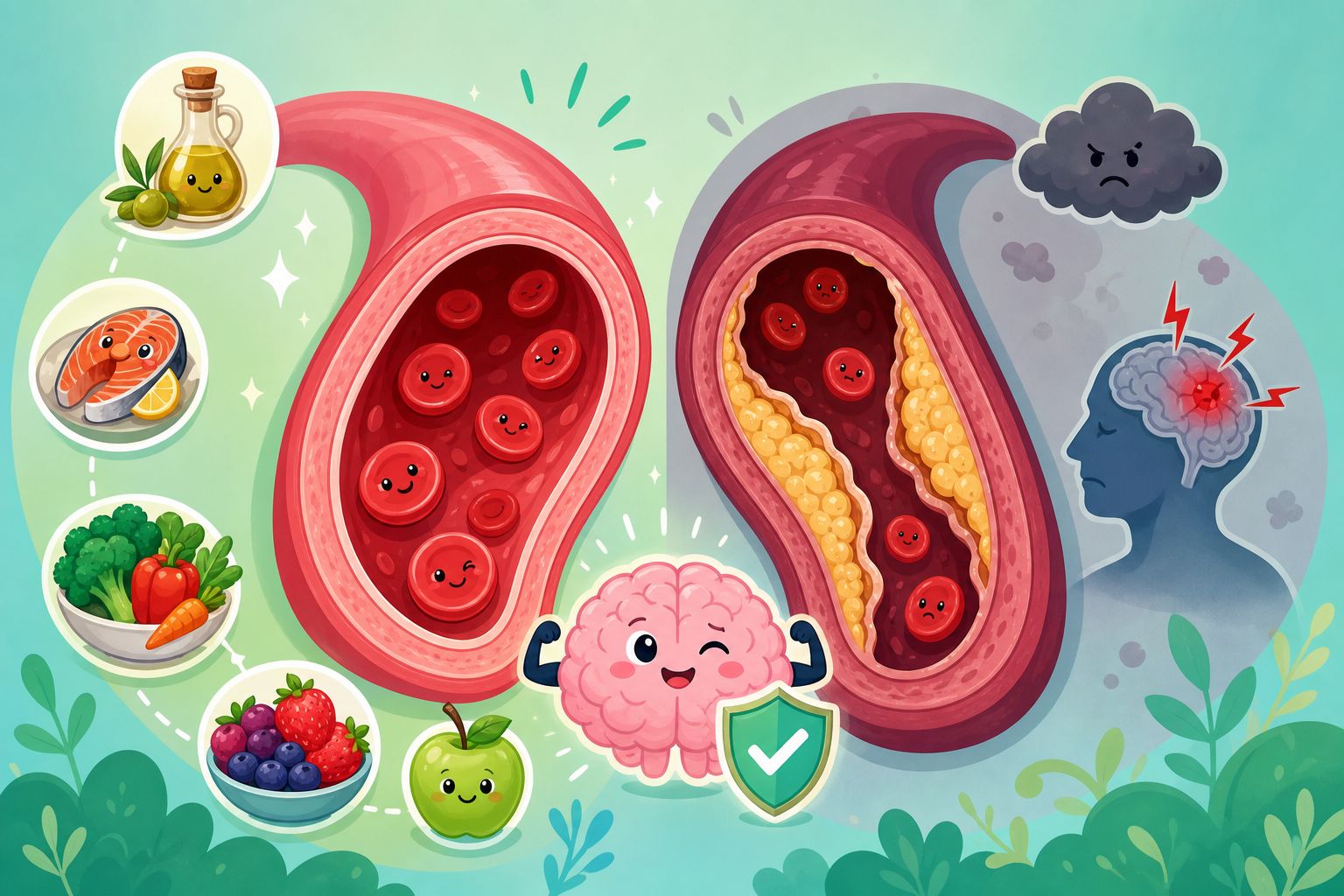
We often maintain our skin and care for our cars, but have you ever thought about maintaining the most important thing in your body—your blood vessels?
As many as 90% of strokes are actually related to risk factors in our daily lives.
And the common goal of these risk factors is to destroy the health of our blood vessels step by step.
How Do Blood Vessels Slowly Deteriorate?
You can think of our blood vessels as a rubber garden hose at home.
When the faucet is turned on too high and water pressure remains high for a long time, the water pipe will not burst immediately.
But over time, the pipe walls will be stretched until they deform and lose elasticity, and the inner walls will be washed by high-pressure water until they are damaged and accumulate limescale.
This is exactly what high blood pressure does to our blood vessels.
The Three-Stage Process of Arteriosclerosis
| Stage | What Happens to the Body | Water Pipe Analogy |
|---|---|---|
| Step 1: Endothelial Damage | Blood pressure remains high for a long term, and blood constantly impacts the innermost layer of cells like a high-pressure water gun, causing the vessel walls to be damaged and inflamed | The inner wall of the water pipe is scratched by high-pressure water flow |
| Step 2: Grease Accumulation | Once the inner wall of blood vessels becomes rough, bad cholesterol and fat can easily stick to the wound | Water scale starts to clog where the water pipe is scratched |
| Step 3: Plaque Formation | Grease and inflammatory cells mix to form hard lumps (atherosclerosis). The blood vessels become narrower and narrower, completely losing their elasticity | The water pipe is narrow and hard, ready to burst at any time |
Not Only High Blood Pressure, the “Three Highs” Are All Enemies of Blood Vessels
| Risk Factor | How It Harms Blood Vessels |
|---|---|
| High Blood Pressure | Acts like a high-pressure water gun, washing the inner wall for the long term and causing damage and inflammation |
| High Blood Lipids | Bad cholesterol (LDL) accumulates grease on the damaged blood vessel walls, forming plaques |
| High Blood Sugar | Blood vessels are soaked in sugar water for the long term, triggering chronic inflammation and accelerating hardening |
If these greases rupture and fall off, traveling with the bloodstream to narrower blood vessels in the brain, they will completely block them, triggering an ischemic stroke.
Why Is There No Feeling Even When a Vessel Is 50% Blocked?
The most terrifying aspect of arteriosclerosis is:
It has almost no symptoms in the early stages.
Blood vessels are extremely resilient organs. Even if they are already clogged with grease, hardened, or even 50-60% blocked, the human body usually still feels nothing.
By the time obvious symptoms appear, they are often 70-80% blocked or more, or the plaque has suddenly ruptured and triggered a stroke.
This is why strokes are called the silent killer.
Weak Warning Signs That Hardened Blood Vessels May Send
When hardening reaches a certain level and starts to affect blood circulation, the body will send out several weak cries for help:
| Location | Possible Warning Signs | What It Represents |
|---|---|---|
| Brain | Frequent unexplained dizziness, sudden memory decline, inability to concentrate | Insufficient blood supply to brain vessels |
| Heart | Chest tightness and pain when climbing stairs or walking fast, relieved after resting | Narrowing of the coronary artery (angina) |
| Limbs | Leg pain and cramps after walking for a distance, needing to stop and rest before continuing | Obstruction of peripheral arteries (intermittent claudication) |
If these signals appear, it means blood vessels have started to have problems, and you should go to the hospital for an examination as soon as possible.
The One Examination Most Worth Doing
For people over 40 or those with the “three highs”, it is recommended to actively select a carotid ultrasound during health checkups.
脖子两侧的 颈动脉 是大脑供血的主干道,而且位置很浅。
医生用超声探头在脖子滑一滑,就能直接看到 血管壁有没有变厚、有没有卡油垢(斑块)、血管狭窄了多少。
Carotid arteriosclerosis usually means that the
cerebralandcardiacblood vessels are also hardening.
This examination is painless and radiation-free, yet it can detect stroke crises early.
How Should You Eat Daily to Protect Your Blood Vessels?
Since arteriosclerosis accumulates step by step, we can also “nurture back” our blood vessels through daily diet.
The dietary approach most recommended by the medical community to protect blood vessels is the Mediterranean diet, the core of which is to eat more natural whole foods, replace bad oils, and eat more fruits and vegetables.
Four Dietary Strategies to Protect Blood Vessels
| Strategy | Practice | Benefits to Blood Vessels |
|---|---|---|
| Replace Bad Oils | Use olive oil, camellia oil, or canola oil for cooking. Reduce saturated fats such as fatty meats, butter, and fried chicken | Reduces bad cholesterol, clearing grease from blood vessel walls like a sweeper |
| Eat More Deep-Sea Fish | Eat mackerel, saury, or salmon twice a week | Omega-3 is a natural anti-inflammatory agent for blood vessels, reducing the chance of blood clot formation |
| Plenty of Fruits & Veggies Daily | Eat more spinach, water spinach, sweet potato leaves, guavas, and bananas | Potassium ions help the body excrete excess sodium, naturally lowering blood pressure |
| Reduce Sodium Intake | Use less dipping sauce, drink less hot pot soup, and eat fewer processed foods | Directly reduces the pressure borne by blood vessels |
Whole Grains Are Also Good Friends of Blood Vessels
Replace part of your white rice with oats, brown rice, or sweet potatoes.
Water-soluble dietary fiber can bind cholesterol in the intestines and excrete it from the body, serving as a free lipid-lowering assistant.
How Should Life Habits Be Adjusted to Keep Blood Vessels Elastic?
Diet is the first line of defense that blood vessels contact daily, but life habits determine the aging speed of blood vessels.
Quitting Smoking Is the Most Effective First Step to Protect Blood Vessels
The probability of stroke in smokers is 2 to 4 times that of non-smokers.
Nicotine and tar in cigarettes will directly destroy the vascular endothelium, causing blood vessels to contract severely and lose elasticity.
No matter how long you have smoked, as long as you quit smoking, the risk of stroke will begin to decline steadily.
Exercise Let Blood Vessels Do “Yoga” on Their Own
Exercise at least 3 times a week, 30 minutes each time (brisk walking, jogging, and swimming are all fine).
During exercise, blood vessels secrete a substance called nitric oxide (NO), which is a natural relaxant for blood vessels, allowing them to dilate, lower blood pressure, and restore elasticity.
Regular exercise is like letting blood vessels do stretching exercises every day, keeping them soft and not stiff.
Ample Sleep, Leaving Blood Vessels No Longer Stressed
Staying up late for the long term and high stress will keep the body in a “combat state”, secreting large amounts of stress hormones, causing blood vessels to contract tensely every day and keeping blood pressure high.
Sleeping 7 hours a day is the basic condition for blood vessels to rest and repair.
Why Are Strokes Especially Common in Winter?
Many people’s blood vessels are already slightly hardened and clogged with grease. They are fine normally, but suffer a stroke when the weather suddenly turns cold.
This is usually because the blood vessels are stimulated by a severe temperature difference.
When skin suddenly touches cold air, blood vessels contract rapidly, and blood pressure spikes within seconds.
For a blood vessel that is already hardened and has lost its elasticity, this instant pressure impact may cause it to burst directly.
Practices to Protect Blood Vessels in Winter
| Scenario | What to Do | Why |
|---|---|---|
| Getting Up | Move your hands and feet in bed first, put on a coat before getting out of bed | Avoid skin touching cold air, which causes rapid vascular contraction |
| Bathing | Start by washing limbs with warm water, let the body adapt to the temperature before washing upward | Avoid hot water directly washing the chest or head, causing severe vascular reaction |
| Going Out | Wear a hat and scarf, keep the head and neck warm | Head and neck blood vessels are dense; keeping warm can stabilize blood pressure |
Pay Attention in Summer Too
Do not rush directly into a room with strong air conditioning when sweating profusely, or blow air directly from the outlet.
Sudden changes in temperature will also be hard for blood vessels to bear.
Preventing strokes does not require expensive health foods. Replacing a spoonful of good oil on the dining table daily, keeping regular exercise weekly, and controlling blood pressure on time is the best investment for blood vessels.
Take good care of your blood vessels, and they can accompany you to go further and healthier.