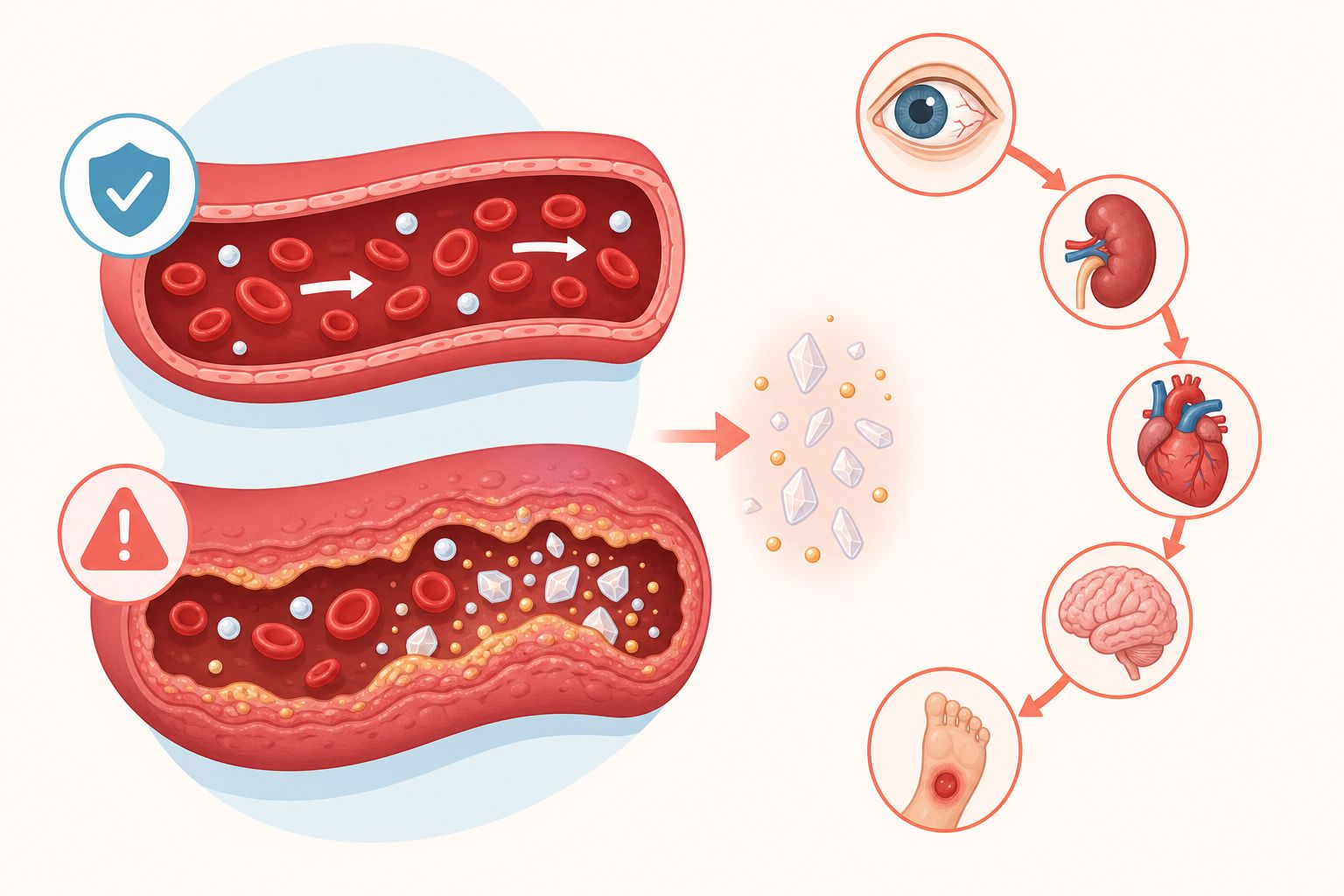
The health check report says “Fasting blood sugar 110 mg/dL, elevated.” You take a look and think:
“Since it doesn’t hurt or itch, it should be fine, right?”
This is probably the most dangerous aspect of diabetes. The true destructiveness of diabetes is never in the blood sugar numbers themselves, but in the fact that high blood sugar destroys blood vessels throughout your body day after day, like chronic acid erosion.
What Happens When Blood Vessels Are Soaked in “Sugar Water”?
Imagine the water pipes in your home. If what flows inside is not clean water but viscous syrup, what will happen to the pipe walls over time?
| Symptoms | Description |
|---|---|
| Rough inner walls | Sugar molecules will attack vascular endothelial cells, turning the originally smooth vessel walls pitted |
| Onset of inflammation | Damaged inner walls trigger an immune response, with white blood cells and bad cholesterol accumulating on the wounds |
| Thickening and hardening of walls | As accumulations increase, the blood vessel passages become narrower and narrower |
| Eventual blockage or rupture | One day, the blood flow is completely cut off, or the fragile vessel walls rupture directly |
This is not a matter of a few days, but a chronic destruction of 5, 10, or 20 years. By the time you feel the symptoms, the blood vessels are already riddled with holes.
The blood vessels in the body are divided into two main categories, and their modes of damage and consequences are completely different:
| Type | Location | Consequences of Damage |
|---|---|---|
| Small vessels (microvessels) | Eyes, kidneys, nerve endings | Blurred vision, proteinuria, numbness in hands and feet |
| Large vessels | Heart, brain, lower limb arteries | Myocardial infarction, stroke, lower limb gangrene |
Damaged Microvessels: Eyes and Kidneys Bear the Brunt
Microvessels are like tubes thinner than a hair, responsible for delivering oxygen and nutrients to the most precise parts of the body.
Microvesselsare extremely fragile, and high blood sugar is the first to break through their defenses.
Eyes: Diabetic Retinopathy
The dense network of microvessels on the retina is responsible for supplying the oxygen needed for the eyes to “see things.” When these microvessels are eroded by high blood sugar:
| Stage | What Happened | Symptoms |
|---|---|---|
| Early Stage | Microvessel walls thin out, beginning to leak blood | Black spots or floaters occasionally appear in the field of vision |
| Middle Stage | Exudates accumulate in the macula (the place of sharpest vision) | Distorted or blurred vision |
| Late Stage | The body tries to grow new vessels to replace them, but the new vessels are more fragile, leading to massive bleeding | Severe vision loss or even blindness |
Diabetes is the leading cause of acquired blindness in adults.
Kidneys: Diabetic Nephropathy
There are millions of glomeruli in the kidneys, each of which is a filter made of tangled microvessels. Their job is to filter waste out of the blood while retaining useful proteins.
When microvessels are destroyed by high blood sugar, the filters start to leak:
| Stage | State of the Filter | Indicators |
|---|---|---|
| Early Stage | Small holes appear in the filter | Microalbuminuria appears in the urine (not always detected by general health checks) |
| Middle Stage | Holes grow larger and larger | Large amounts of protein leak out, and the body starts to experience edema |
| Late Stage | The filter is almost useless | Kidney failure occurs, requiring dialysis |
The majority of dialysis patients are caused by diabetes.
Damaged Large Blood Vessels: Heart and Brain Suffer
If microvascular disease is a “chronic depletion,” macrovascular disease is a “fatal blow.”
Why is Cardiovascular Risk Particularly High for Diabetic Patients?
High blood sugar accelerates atherosclerosis. Simply put, fat, cholesterol, and calcium constantly accumulate on the inner lining of blood vessel walls, forming gruel-like plaques.
The rate of arteriosclerosis in diabetic patients is 2 to 4 times faster than in average people.
| Complication | Probability | Severity |
|---|---|---|
| Myocardial Infarction | The risk for diabetic patients is 2 to 3 times that of ordinary people | Cardiac blood vessels are suddenly blocked by plaques |
| Stroke | Risk increases by 1.5 to 2 times | Cerebral blood vessels are blocked or ruptured |
| Peripheral Arterial Occlusion | Risk increases by more than 4 times | Insufficient blood flow to lower limbs, requiring amputation in severe cases |
About 50 to 80% of diabetic patients eventually die from cardiovascular disease, which is the biggest killer of diabetes.
Not Just Blood Vessels: Nerves Also Suffer
Nerves require blood vessels to supply nutrients to function properly. When microvessels are destroyed, nerves gradually degenerate due to long-term “starvation.”
This is diabetic peripheral neuropathy.
Common Symptoms
| Symptom | Description |
|---|---|
| Numbness and tingling in hands and feet | Like being pricked by needles, or feeling like wearing thick gloves |
| Dull sensations | Stepping on a nail but not feeling pain |
| Non-healing wounds | No feeling of injury + poor blood circulation = wounds decay without knowing |
The Most Dreaded Result: Diabetic Foot
Because pain cannot be felt, small wounds on the feet may be ignored. Combined with poor blood circulation, wounds cannot heal and infections begin.
If the infection spreads to the bone, it may eventually require amputation.
Controlling Blood Sugar is Protecting Blood Vessels Throughout the Body
The good news is that all of these complications can be prevented or delayed by controlling blood sugar.
The essence of controlling blood sugar is to prevent your blood vessels from continuing to soak in sugar water.
| Indicator | Target Value | Meaning |
|---|---|---|
| Glycated hemoglobin (HbA1c) | < 7% | Reflects average blood sugar over the past 2 to 3 months |
| Fasting blood sugar | 80 to 130 mg/dL | Basal blood sugar upon waking up in the morning |
| Postprandial blood sugar | < 180 mg/dL | 2 hours after eating |
Controlling blood sugar is never just for making the health check report look good, but to protect your blood vessels and organs throughout your body from collapse.
If blood vessels do not deteriorate, these terrible chain reactions will not start at all.